GROSZ 2023.161 2023.163
By Nina Miall
'Towards a Collapsing World: German Expressionism' February 2026
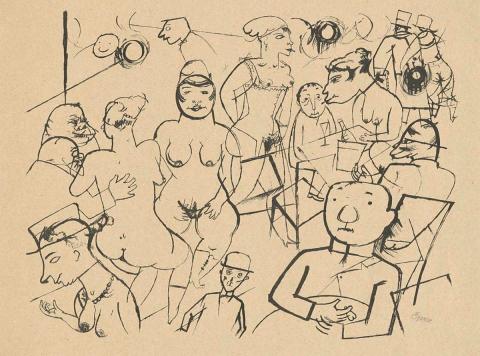
Nacht-café (für Dr Benn) offers a scathing portrayal of Berlin nightlife at a moment of profound social crisis, depicting a crowded interior filled with grotesquely caricatured figures, whose exaggerated features convey both decadence and despair. The work is dedicated to poet and physician Gottfried Benn, whose writings dissected what Benn saw as the moral decay of modern life.
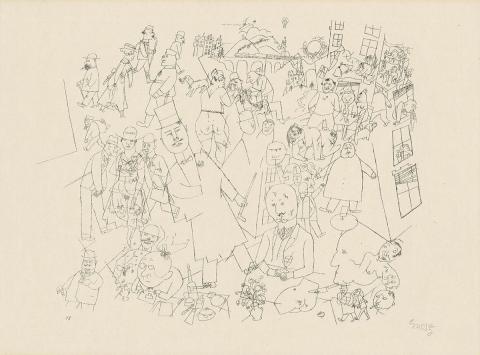
Created as part of his illustrated book Ecce Homo, published in 1923, Bürgerliche welt (World of the bourgeoisie) adopts a similarly satirical tone. In simplified line drawings approaching caricature, George Grosz depicts lecherous, sexualised figures living lustful, violent lives as they move around a distorted cityscape. With savage honesty and dark humour, he captures a world in transition, suggesting the moral hypocrisy and complacency of the Weimar Republic .
Grosz was one of the key figures of Dada – a radical avant-garde movement that emerged in Berlin in response to World War One, using satire and provocation to attack the bourgeois culture of the Weimar Republic . Rejecting Expressionism’s preoccupation with inner suffering, Berlin Dada instead emphasised the social responsibility of art, wielding it as a weapon for social and political critique.