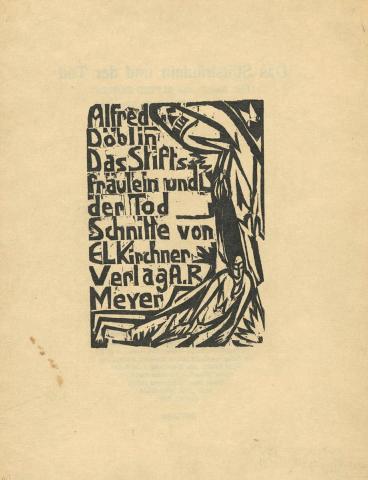
KIRCHNER 2023.067a-e
By Nina Miall
'Towards a Collapsing World: German Expressionism' February 2026
Ernst Ludwig Kirchner’s woodcut illustrations for German author Alfred Döblin’s novella, Das Stiftsfräulein und der Tod (The Canoness and Death) (1913) stand among the most powerful examples of early German Expressionist book art. Exploiting both the raw language of the woodcut and printmaking’s capacity for serialising a narrative, these five prints tell the story of a woman living a monastic life in a religious community and describe her fears and desires as she anticipates the arrival of death. Dramatic dark lines foreground the physicality of the medium, while the woman’s gestures convey her inner torment as she contemplates her morality.
Over the course of the five images, we see the Canoness – isolated and lonely – attempting to occupy herself while she awaits the angel of death, who arrives in the final scene. Closely integrated with the typography, Kirchner’s illustrative woodcuts – which were the first of their kind for the artist – do not merely accompany the story but actively shape its emotional rhythm. The collaboration exemplifies the Expressionist ideal of Gesamtkunstwerk (German for ‘total work of art’), bringing different art forms – such as literature, drama and visual art – together to create a compelling and cohesive whole.