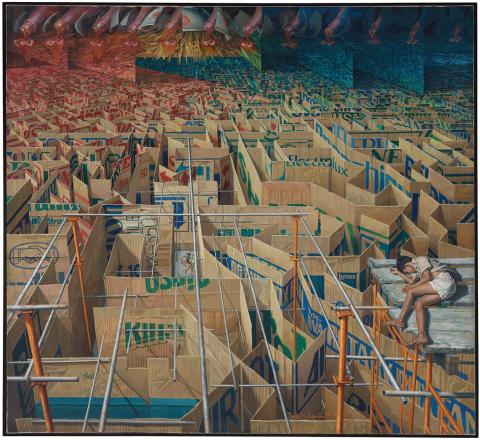
SUPRIA 1993.404
By Ellie Buttrose
'City Before Our Eyes' March 2026
Far from the idealised or romanticised subjects typical of photorealist painting, Dede Eri Supria’s epically scaled and intricately rendered paintings confront the ugliness and chaos of urban life. In his ‘Labyrinth’ series, Supria uses illusionistic realist techniques within illogical settings, depicting vast, maze-like slums constructed from commercial packaging and viewed from an elevated perspective. The painting suggests that the human suffering of urban poverty is a consequence of capitalism and consumerism.
Inspired by his father’s work as an advertising painter, Supria’s interest in photorealism was fostered while assisting in the studio of Indonesian social realist Dukut Hendronoto and during his studies at art school in Yogyakarta. In 1977, he joined the politically engaged Gerakan Seni Rupa Baru Indonesia (Indonesian New Art Movement), whose search for an ‘aesthetics of emancipation’ saw him apply his considerable talents to social criticism.