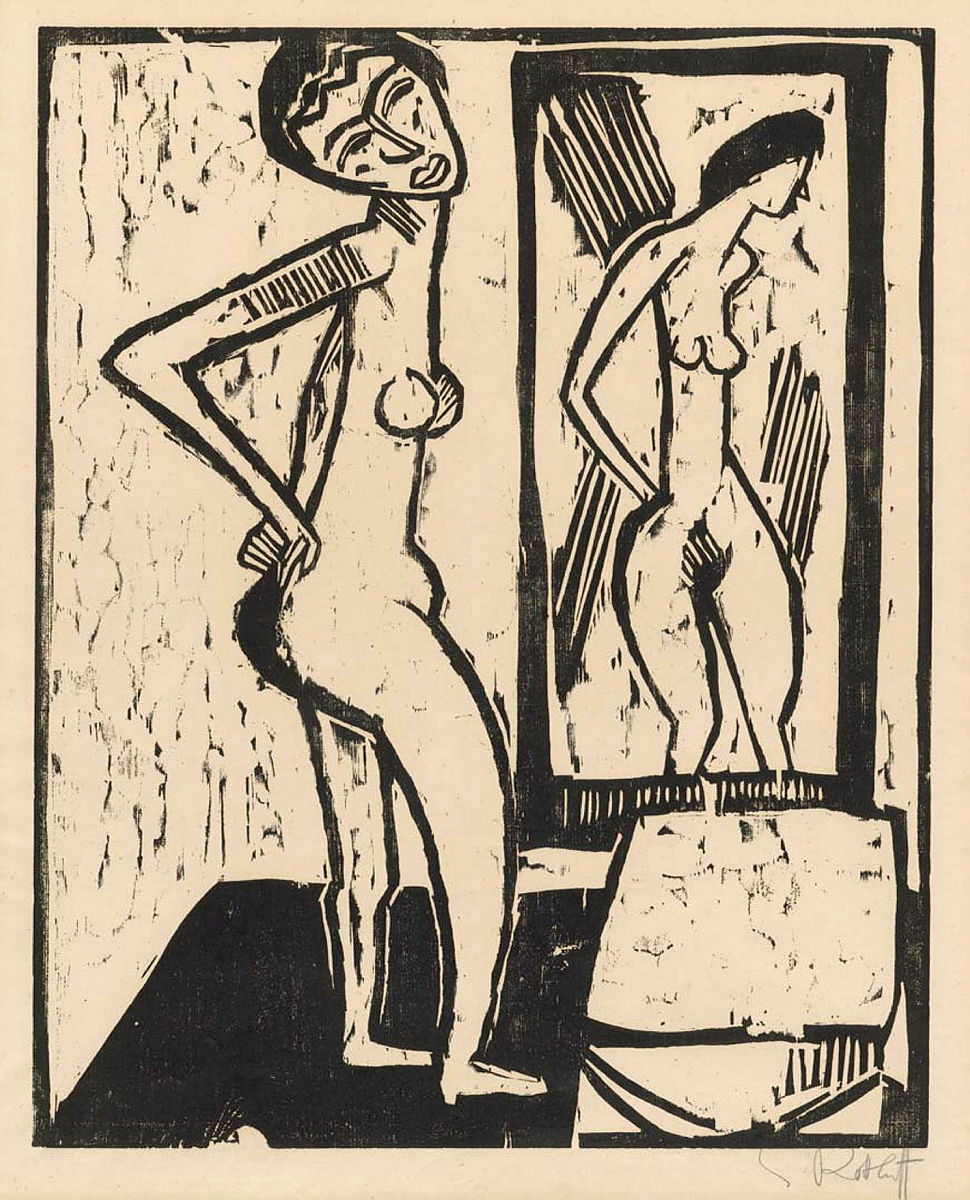
Using stark contrasts and jagged, simplified forms, Karl Schmidt-Rottluff transforms an intimate moment of self-reflection into a charged psychological encounter in this woodcut. The female figure is rendered with angular lines and bold black contours, her body fragmented and compressed within the pictorial space. In doubling the statuesque figure, the mirror intensifies the sense of tension and introspection. Mädchen vor dem spiegel (Girl before a mirror) is a compelling example of the German Expressionists’ revival of the woodcut as a modern artistic medium.
Schmidt-Rottluff’s carving technique suggests an awareness of Cubism and artists such as Georges Braque and Pablo Picasso, who took inspiration from the art of Africa and Oceania. Having encountered traditional African sculptures and wooden relief carvings from Micronesia at Dresden’s ethnographic museum, Schmidt-Rottluff was heavily influenced by their elongated, totemic bodies and highly stylised faces. Produced on the eve of World War One, this work reflects broader anxieties about identity, modernity, and the instability of the self, exemplifying the German Expressionists use of the human form to explore inner states of turmoil rather than external beauty.