Curator's perspective: The cubic structural evolution project
By Geraldine Kirrihi Barlow
'Presence' January 2026
Audio file
This installation fills the gallery with long, white tables piled high with thousands of small white LEGO bricks. The tables form a wide rectangular surface, low enough for both children and adults to reach comfortably.
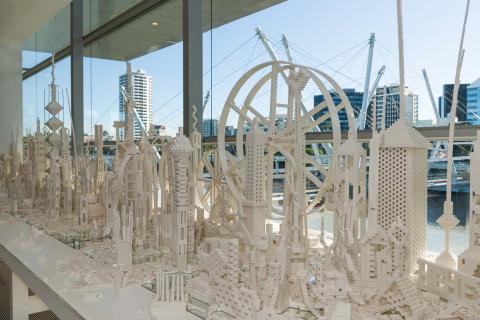
Spread across the surface are countless constructions built from the same uniform white pieces. Some are small and simple – a single tower or a wall only a few bricks high. Others are tall and intricate, rising to half a metre or more. Shapes resemble skyscrapers, bridges, domes, towers and imagined structures. Together they present a sprawling cityscape. Beneath and between the constructions lie scattered mounds of loose bricks, ready to be used for further building.
Visitors are active participants in the work. Throughout the exhibition, people sit or stand around the tables, taking handfuls of bricks and adding to the evolving city. Each new contribution becomes part of the whole, with later visitors building onto or reshaping what has been left before them. The result is a landscape that is always in flux – partly planned, partly improvised and constantly remade.
The overall effect is of a collaborative structure that grows and shifts over time. The uniform whiteness of the LEGO bricks gives the city a sculptural, architectural quality, while every addition carries the trace of individual hands.
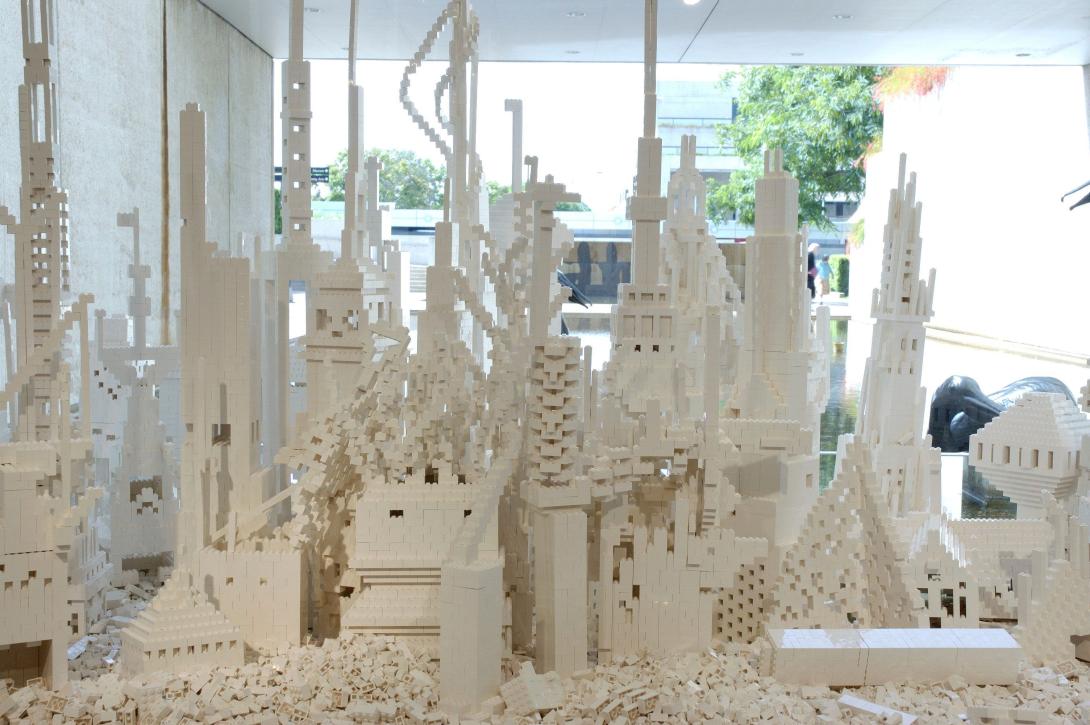
Olafur Eliasson / Denmark b.1967 / The cubic structural evolution project 2004 / ABS plastic / Installed dimensions variable / Purchased 2005. Queensland Art Gallery, Foundation Grant / Photograph: QAGOMA
Listen and learn more
Audio file
As we move out into the bright light of the central atrium gallery [when touring 'Olafur Elliason: Presence', 2026], you'll see The cubic structural evolution project, a long table of white Lego where you can sit and work with your friends, your neighbours, other visitors to the gallery to build and imagine a city all in white bricks of Lego.
You might take inspiration from forms that you see nearby. Or perhaps even grab a little bit of that building and add it onto yours. Look at how the buildings connect, the forms and invention and innovation, sometimes made by adults or children.
This is a place of potential and collaboration. You might start something today and come back next week and see that someone else has continued it, or innovated in another way. This artwork was first made in 2004. The Queensland Art Gallery bought it a year later. It has been a beloved work for over 20 years now, with children growing into adults, very excited to return and, make their new buildings.
So, in this work we see Olafur again involving us, the visitors, his audience, wanting our perspective, our creativity, and looking at how art artwork can be used to welcome us to all come together.
Nearby, if you walk down towards the river and the trees, you'll see a sculpture made up of a lighthouse lens. This lens originally comes from Queensland and a lighthouse. It's called a Fresnel lens, it's been fitted with diachronic glass, and it sends out a signal across the river. The artwork is called Your lost lighthouse. Perhaps the lighthouse itself is lost, or it's speaking to us as we seek to find our way?
I knew that the lighthouse sent out flashes of light, but it wasn't until like quite late in our planning that I learned that it is in fact, sending out an SOS signal: three long bursts of light, three short bursts, and three more long bursts. So, it is a beautiful artwork, but perhaps it also expresses something of our collective dilemma: ‘Where do we go, and how do we take this journey together?’
Digital story context and navigation
Explore the story
'Olafur Eliasson: Presence'
Dec 2025 - Jul 2026