Michael Parekōwhai: Acts II
By Maud Page
April 2004
Recognised as a significant New Zealand artist, Michael Parekōwhai is known primarily as a sculptor. His work is acclaimed not only for its meticulous finish, but also for the way it audaciously engages with ideas about the creation and place of culture. Often playing with scale, Parekōwhai's objects comment on significant issues such as national identity, colonial history and some of its legacies such as cultural appropriation. Through their complexity, his works also refer to everyday, personal narratives. One of Parekōwhai's most notable traits is creating the possibility of multiple interpretative entry points to his practice without overloading the objects. Combining a minimalist aesthetic with a Dadaist sense of disruption and humour, Parekōwhai creates works that are deceptively simple in appearance and execution. The artist has consequently been variously called a 'provocateur and challenger'1 and a 'showman and saboteur'.2
Acts II 1994, formed part of the 'Kiss the Baby Goodbye' exhibition that launched Parekōwhai's career. Art critic and curator Justin Paton has commented that the sculptures in this show 'toyed with art history and made art from toys, assailing the canon with such panache that they soon became canonical'.3 Through nine very large works presented as kitset models, Parekowhai examined key ideas that have continued to form the basis of his practice to date. The first of these is his subscription to Dadaist principles of engaging with the everyday. In this case, he specifically addressed learning tools such as the jackstraw, which appear straight from the manufacturer as 'simple plastic kitsets that you find in a Weetbix box or the local toyshop'.4 With Acts II, the educational role of the jackstraw takes on a more sinister role and leads to Parekōwhai's second interest, which is the formulation and functioning of culture. Primarily used as a game with which to mentally and physically challenge children, the jackstraw encourages dexterity and teaches risk calculation. In Acts II, the game has the additional property of embodying all the necessary tools for colonisation: rifles, canon rods and swords for the initial conquest; then saws, axes, ladders, pitch forks and spades to tame the new land. Parekōwhai could be understood as making an analogy between the educational tools used by the dominant pākehā (New Zealanders of European descent) culture and the continuation of colonial patterns of thought. Parekōwhai is not didactic.
The third aspect of his practice is that his work always contains some form of ambiguity so that its reading resists a prescriptive outcome. In Acts II, the kitset also contains tools such as crutches and walking sticks which, although suggestive of battle and sickness, are also objects which assist and comfort. Through this latter reading, some of the tools could also be understood as ones which build rather than destroy. Parekōwhai mentions the kitsets as being 'tools or agents of cooperative learning'.5 He evokes the role of childhood memories where objects loomed larger in the imagination: '...my work slips in through the memory of what things were like. The appreciation of all that remains glows bigger and brighter than ever.'6
Parekōwhai has been called 'a master illusionist [who] disrupts ideas of authenticity, offering fakes as real and originals as replicas'.7 Such a claim can be understood as constituting the fourth comment on this artist's way of thinking, which shows his engagement with the work of Marcel Duchamp. Parekōwhai aims to disrupt expectations of his work and particularly resists a recognisable Māori aesthetic and cultural content. Acts II appears as a serialised object primed with a glistening non-descript colour that, in fact, ideally masks its masterful hand-carving. Carving is seen as the quintessential Māori customary practice, but through his deception Parekōwhai manages to evade alignment with his predecessors and create new possibilities for what contemporary Māori art might constitute.
Endnotes
- Justin Paton, 'Special agent: Michael Parekowhai's generous duplicity', in Art New Zealand, no. 103, Winter 2002, pp.58–63.
- Jim and Mary Barr, 'The indefinite article: Michael Parekowhai's riff on representation', in Art Asia Pacific, no. 23, 1999, p.73.
- Paton, p.59.
- Barr, 1999, p.75
- Barr, 1999, p.75
- Barr, 1999, p.75
- Maud Page, 'Kitset cultures' [exhibition pamphlet], djamu Gallery, Australian Museum, Sydney, 1999, unpaginated.
Connected objects

Acts II 1994
- PAREKŌWHAI, Michael - Creator
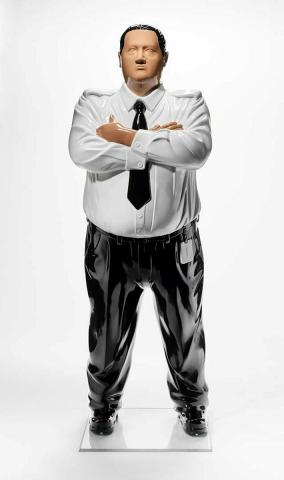
Kapa Haka (Whero) 2003
- PAREKŌWHAI, Michael - Creator