A World View: The Tim Fairfax Gift
December 2016
Our view of the world is forever in flux. It shifts, unfolds and is perpetually reshaped. Our perspective might be radically reformed as we ponder the movement of celestial bodies in the night sky, or change unexpectedly when we see our own reflection suddenly transformed in a broken mirror. As we observe, think and seek to understand, our world view deepens. Every time we reconstruct our own internal model of the world we synthesise personal experience and a vast network of abstractions. The mind is highly sensitive to pattern and anomaly — from the earliest moments of cognition we stretch our thoughts to encompass space, time and the lives of others. Art accelerates this process, acting as a mirror to the world, helping us to channel, refract, activate and recalibrate our understanding of the familiar, to see the world anew, to keep our imagination alert and agile, to embrace change.
‘A World View: The Tim Fairfax Gift’ honours the remarkable and far-reaching generosity of Tim Fairfax, AC. Fairfax has supported the Gallery in acquiring more than 70 ambitious contemporary international artworks. From vast installations to intimate sculptures, these works have enriched the experience of many visitors to the Gallery. They connect Brisbane with cities across the globe and enable a deeper understanding of human experience and artistic expression.
Timo Nasseri’s Epistrophy VI 2012 is emblematic of this power to shift the way we see and understand the world. Its polished, reflective surfaces gather every detail of the surrounding space, including our own presence, into a sublime geometry. We see ourselves in this work but in an unfamiliar way: Nasseri fragments and reconstructs our perspective, offering us an experience of beauty deeply connected to the larger cosmos.
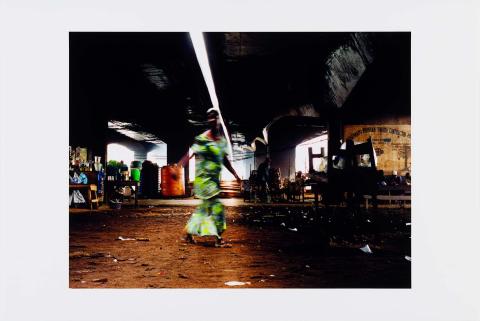
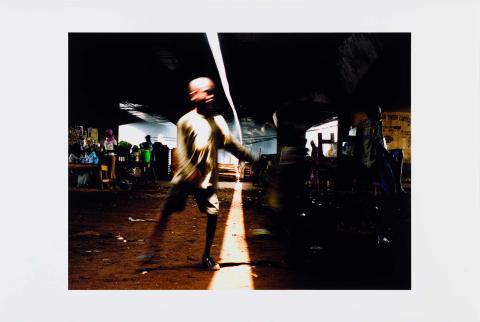
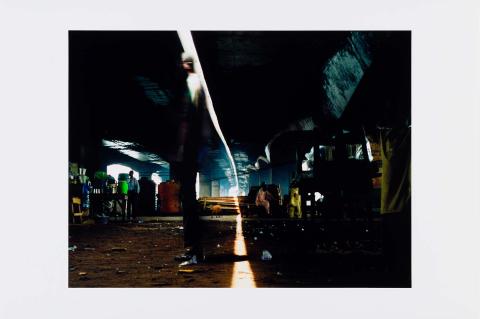
‘A World View’ presents many artworks that combine abstract models of the world with our own experiences of moving through space. Lithuanian artist Zilvinas Kempinas’s installation of magnetic tape columns makes something monumental and abstract from an everyday material. As we walk through this forest of perfect cylinders the columns shape-shift, moving from solid to light. Perception and the position of our body make all the difference. To move through space, to sense our body in motion, is one of the great pleasures of being alive. It is an experience so familiar that we sometimes overlook its wonders. This is an experience also captured in Uche Okpa-Iroha’s photographs, which dramatically catch the movement of his Nigerian compatriots across the narrow band of light shining through an urban underpass, and by Shigeyuki Kihara who adopts the movements of a transcendent being in her video work Siva in Motion 2012. Familiar everyday bodies are lifted from daily reality into a more sublime and timeless realm.
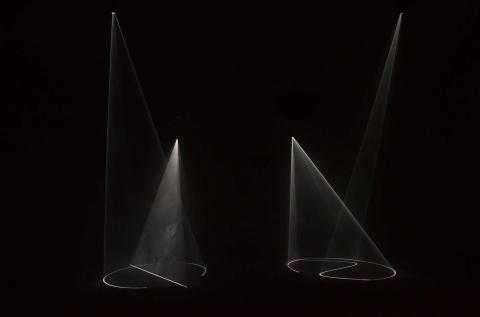
Anthony McCall’s solid light sculptures rewrite the way we read the mass and boundaries of our body. Through Crossing 2016, a vast new work created for QAGOMA that will premiere in the second stage of this exhibition, we become closely aware of how our body occupies space. For this work, the New York-based artist combines light and the sound of a breaking wave to draw us into a space where a sequence of abstract forms and volumes is played out on a grand scale. Although abstract, they evoke the memory of specific experiences — shafts of light falling through cloud onto a windswept beach, or the curved triangle of a wind-filled sail. We can literally step into the light in McCall’s work. The volume of our own body changes, as parts are lit: our arm might be solid for a moment and then fall away into blackness as we move, or the light itself shifts. McCall stretches the way we encode perception and, most intriguingly, proprioception — our sense of the body and its location as we move through space. He reminds us of the wonder of our senses, and the rich interplay between movement, memory and experience.
In a similar way, Tomás Saraceno’s 2009 Biospheres function as a conceptual bridge between our own bodies and the wider world: the large, transparent spheres, held in a web of black cord, are suggestive of particles of oxygen — powering our bodies as they move through the blood — as much as sealed, protective environments, the perfect retreat. Saraceno presents us with ideal structures derived from nature and mathematical models. They could be spider webs, or supernovas, cellular structures or utopian models for a future city. While there is much that we might recognise in such forms, we must also make our own decisions about the balance of features that is most meaningful to us.
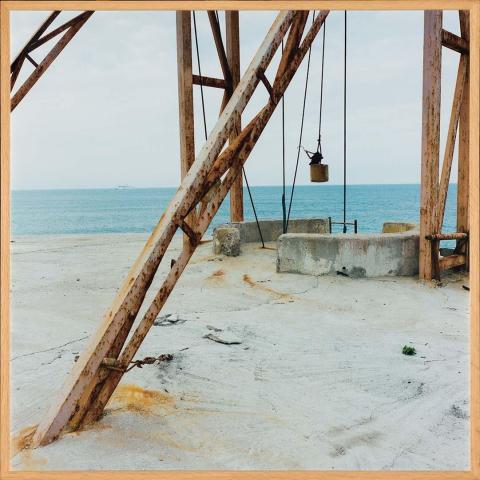
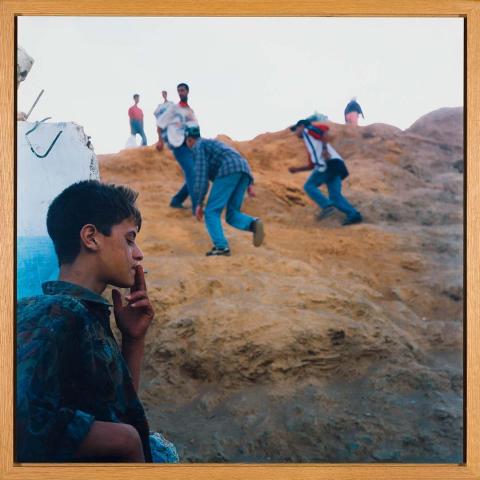
Artists open up unexpected possibilities for movement, as well as reminding us when they are closed off. Gordon Matta-Clark’s seminal 1977 film Office Baroque documents the artist cutting through a building in Antwerp — carving clear open space from an apparently solid structure. Here it is possible to walk through walls. Yto Barrada’s photographs depict the site of a tunnel that was to be constructed linking Morocco and Europe, a defunct project that now seems sadly obsolete in the current geopolitical framework. In this pair of images, we see a group of young men scrambling up the hill, another man pausing to light a cigarette. Barrada records motion and the moments in between, movement at a point where larger transitions are blocked.
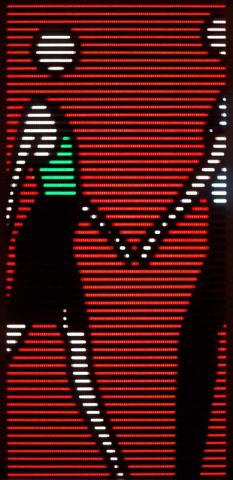
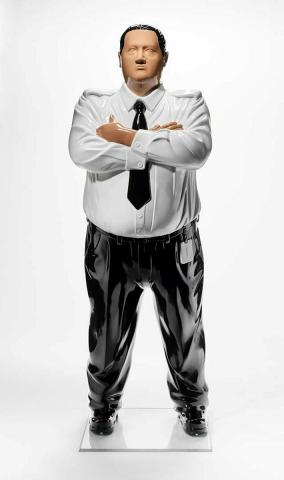
Julian Opie’s LED light work People walking. Coloured 2008 offers a mesmerising portrait of strangers forever in motion. Abstract and ideal, we see men and women move across a glowing field of red. These ‘smoothed out’ people with their round, white heads are so generically formed that they suggest an unsettling kind of sameness, an ironing out of difference, body type or character. Michael Parekowhai’s Kapa Haka (Whero) 2003 presents another kind of flattened out ‘everyman’, transforming a museum security guard into a smooth, shining sculpture. Solid, staunch and brown-skinned, he is at once imposing and suddenly visible as an artwork, requiring us to think about what it means for us to share the space with this man-symbol-sculpture.
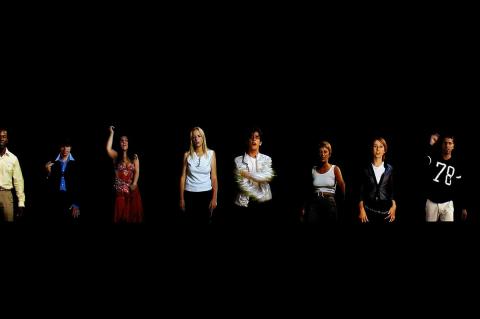
Beat Streuli’s gleaming, expansive photograph Bruxelles 05/06 2006 transforms a different group of familiar everyday characters. Three men walking down the street are lifted out of time and made special, monumental. Not looking directly at us, they each seem to walk in a world of their own. What does it mean to see people such as ourselves drawn from the streets and reflected in this way? Do we look for an idealised vision of who we might be, or the more complex and surprising texture of our true selves? South African artist Candice Breitz advertised for Michael Jackson fans to perform his album Thriller 1982, and she presents us with 16 synchronised performances. On their own, each performer is special and unique. Together they reveal the larger patterns of a global culture that bind us: they touch us, make us smile and tempt us to join them and dance. They remind us of the wonderful idiosyncrasy of human expression. Robin Rhode’s evocative video work Promenade 2008 uses human movement to question what we can control and what controls us. A silent performer enters a simple grey and white space; he moves ceremonially, with deliberate gestures, as a mime artist might. We see him motion towards a white diamond-shaped form, which floats down from above, and is then joined by another. Is our protagonist in charge of these forms or controlled by them? We see them proliferate and slowly hem him in. Promenade has a gentle humour mixed with sadness; as the film ends we see the performer holding a single white diamond gingerly, as if from its tail. Is this something precious, or something to be wary of?
Francis Upritchard’s collected group of white-clad figures are also caught in a complex and slightly ambiguous dynamic. Both tender and grotesque, with their mottled fleshy skin and near-closed eyes, they appear to be sharing a ritual moment or strange dance all of their own. They seem to move to a shared song, even if the purpose of such a gathering of figures remains unclear. Are they dancing, tossing a ball, or warding off evil spirits?
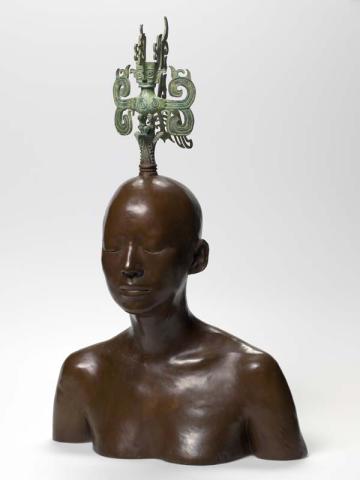
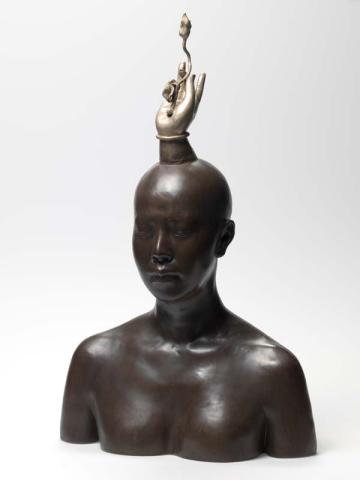
The eyes of the life-size bronze busts of Ah Xian’s ‘Metaphysica’ series are also closed; in this instance their focus appears to be directed inward. We see the ‘action’ of thinking. The interior world of each subject is suggested by the objects that crown each head — a rabbit, a red fish, a cicada on a leaf, a deity. These works bring calm into balance with complexity. They seem to capture the universe of possibility within each of us.
‘A World View: The Tim Fairfax Gift’ offers different speeds and subjects of reflection, different ways of knowing the world around us: deep, slow interior knowledge, the knowledge that comes with moving our body to a popular song, a sense of wonder as our body forms and dissolves in a beam of light. The human body and human experience of the world is at the centre of all of these disparate works, drawn as they are from across the globe. Together they allow us to develop a richer perspective on our place in the world, and to participate more fully in the process of shaping what it might become.
Feature image: Timo Nasseri’s polished stainless steel work Epistrophy VI 2012, installed for ‘A World View: The Tim Fairfax Gift’, GOMA, October 2016 / Purchased 2012 with funds from Tim Fairfax AM through the Queensland Art Gallery Foundation / © Timo Nasseri / Photograph: M Sherwood, QAGOMA
Connected objects
Crossing 2016
- McCALL, Anthony - Creator

Siva in Motion 2012
- KIHARA, Yuki - Creator

Action 2015
- UPRITCHARD, Francis - Creator

White knight 2012
- UPRITCHARD, Francis - Creator

Run 2012
- UPRITCHARD, Francis - Creator

Rider 2012
- UPRITCHARD, Francis - Creator

Bearer 2012
- UPRITCHARD, Francis - Creator

Biosphere 05 cluster 2009
- SARACENO, Tomás - Creator

Biosphere 2009
- SARACENO, Tomás - Creator

Biosphere 2009
- SARACENO, Tomás - Creator

Biosphere 02 2009
- SARACENO, Tomás - Creator

Epistrophy VI 2012
- NASSERI, Timo - Creator

Columns 2006
- KEMPINAS, Zilvinas - Creator

Office Baroque 1977
- MATTA-CLARK, Gordon - Creator
Kapa Haka (Whero) 2003
- PAREKŌWHAI, Michael - Creator

Metaphysica: Baby boy 2007
- AH XIAN - Creator

Metaphysica: Cicada on leaf 2007
- AH XIAN - Creator

Metaphysica: Red Fish 2007
- AH XIAN - Creator

Promenade 2008
- RHODE, Robin - Creator

Human human - Bust no.5 2001
- AH XIAN - Creator

Metaphysica: Rabbit 2007
- AH XIAN - Creator

Bruxelles 05/06 2006
- STREULI, Beat - Creator