Khadim Ali's 'Rustam-e-pardar (Rustam with wings)' series
Rustam, the powerful winged god of Persian legend, is Khadim Ali's main source of inspiration in the series 'Rustam-e-pardar (Rustam with wings)'. Rustam is the champion and hero of the epic Shah-nameh (also known as the 'Book of Kings' or the 'Epic of Kings'), which was written by the renowned tenth-century Iranian poet, Abu al-Qasim Firdausi (hailed as the Homer of Iran). For centuries, popular tales from the Shah-nameh have passed down through generations as an oral tradition. As a young child Ali listened to his grandfather sing these dramatic sagas.
The Shah-nameh begins with the creation of the world and recounts the varied and illustrious stories of the ancient Persian (Iranian) Kings and the colourful acts of bravery and deceit by hero and villain alike. The story documents historical events, such as the acceptance of the Zoroastrian faith1 and Alexander the Great's invasion, to the conquest of Iran by the Arabs.
The Shah-nameh contains very few Arabic words and is considered a masterpiece of Persian national literature. Since the fourteenth century, episodes of this poem have inspired miniature artists, particularly those descendants of the Persian region (present day Iran, Afghanistan and north-western Pakistan). Rustam is celebrated as a god of divine powers and is analogous to the heroic reputation of Hercules in Greek and Latin culture.
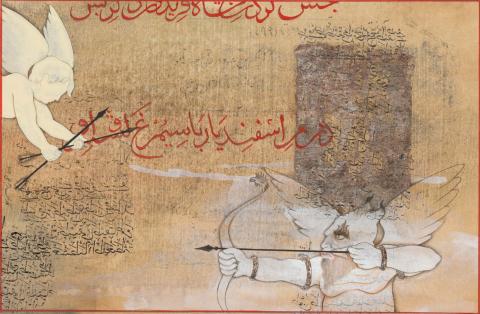
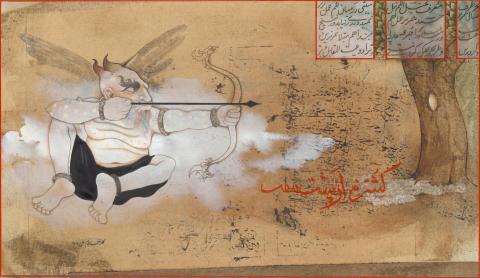
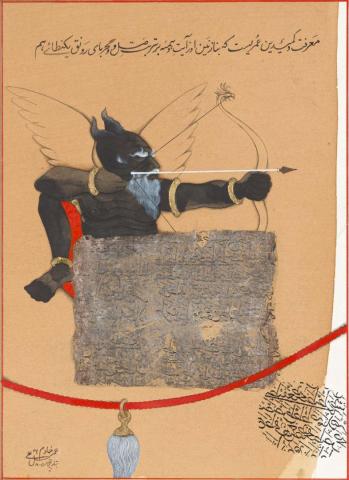
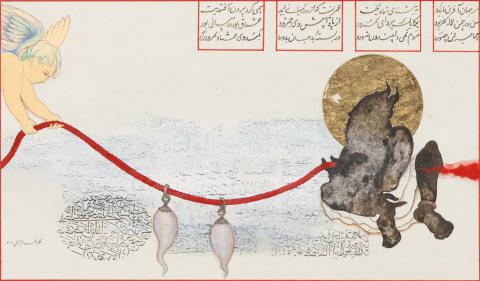
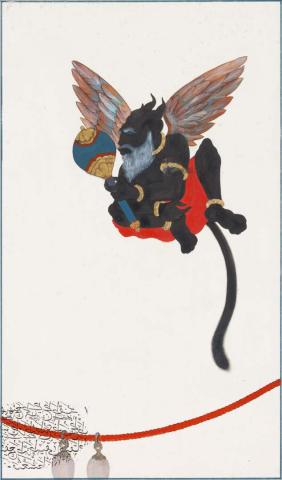
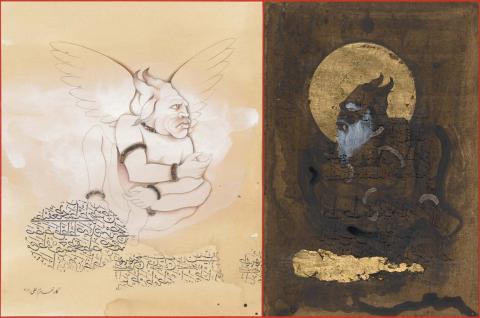
During a visit to Bamiyan in Afghanistan, Ali worked with several children on a series of drawings which include black demon creatures with wings — a direct reference to the Taliban calling themselves 'Rustam e pardar' (Rustam with wings). Taking direct influence from these children's drawings, Ali stylistically depicts Rustam of the Taliban as two separate demons in black and white. According to Ali the Shah-nameh's concept of black and white is not an opposing duality of good versus evil; rather these colours indicate hypocrisy, falsity or deceit.
Ali's finely rendered, yet demonic figures reference the Taliban's controversial identification with Rustam as their spiritual leader and fighter for the holy cause of Islam. In the name of this respected historical figure, whose gallant tales of defending his people against demons are well known, many thousands of Afghanis have perished in the Taliban's mission to make Afghanistan an Islamic state.
With his bow and arrow poised ready for the kill, Ali has depicted Rustam's impostor as a wizened demon-creature who is illustrated with the popular graphic qualities of the supernatural: he has a horn-like head, fiery eyebrows and feathered wings. According to the tales of the Shah-nameh it is said that Rustam failed to defeat a black demon and so an angel brought down a divine arrow and told him to aim for its eye. In Ali's works, the angel is depicted with arrows but also assists in carrying a red rope which is threaded with jewel-like objects — a memorial to those who died by hanging under the Taliban's regime. Arabic text is written in the shape of the Taliban circular seal while Persian script taken from the Shah-nameh may be found in block form in the upper right frame of two of the works.
Endnotes
- The religious system founded by Zoroaster and set forth in the Avesta (Zorastrian holy book), teaching the worship of Ahura Mazda in the context of a universal struggle between the forces of light and of darkness.