Justene Williams: Hepworth's Hole
By Grace Jeremy
Justene Williams works across a wide range of media, including performance, sculpture, photography, and video. Her practice is known for its art historical references to modernism and use of found objects in the avant-garde tradition of the readymade, as well as examining contemporary cultures and the female body. Williams grew up around discarded objects (her father owned a wrecking yard) and since her childhood she has constantly imagined new lives for the items she comes across.1 Hepworth’s Hole 2021 is an installation comprising a sculpture and digital video. The work explores society’s growing relationship with consumerism and demonstrates her art historical connection with the avant-garde.
Hepworth’s Hole is closely related to Williams’ larger installation The Vertigoats. This work examines contemporary fashion and wellness industries that are rooted in conformity and consumerism, while also probing the role of digital technologies in alienating individuals from the world around them — an ironic consequence of a hyper-connected world.2 Model-esque and two metres tall, the mannequin’s arms, legs and torso in Hepworth's Hole are all different bright colours, as if clothes-store leftovers have come to life. The figure’s oversized arms, tipped by fake acrylic nails, parody the absurdity of current beauty standards. Williams often breaks with the conventions of idealised bodies, stating: ‘I started to create [the mannequins] with different bodies, because it used to really annoy me how they were all the same’.3
Wedged into the mannequin’s skull is a circular, convex mirror, the kind used to see around the corners of shopping mall carparks. Williams regularly uses these mirrors in her installations, allowing the audience to ‘activate’ her artworks.4 As the viewers move in front of Hepworth’s Hole, their bodies are warped in the mirror’s reflection, distorted like the mannequin’s. Presenting viewers with their own image, the mirror also serves to remind them that they live in an age of surveillance and social media. Perched atop the figure’s head, the mirror transforms the sculpture into a strange deity — perhaps a spiritual embodiment of our consumer- and image-driven society.
In addition to its contemporary commentary, Hepworth’s Hole looks backwards into art history. A fluorescent lighting tube is inserted through a perfect hole in the mannequin’s torso, like a stake through the heart of a demonic creature. The punctured torso and the work’s title, Hepworth’s Hole, reference the work of avant-garde artist Barbara Hepworth (1903–75), one of the leading figures in British modernism, known for the characteristic holes through her abstract sculptures. The hole in the mannequin becomes a portal between Williams and Hepworth. Writing for the Tate, Jeanette Winterson argues for these capacities in Hepworth’s holes:
Hepworth’s holes are also tunnels or worm-holes making a route through time. Art connects us to the past, not only by reminding us of where we have been, individually and collectively, but by renewing in us the creative energy that all humans share, across time. The hole is a way back and a way forward.5
In invoking Hepworth’s visual language, Hepworth’s Hole collapses the temporal distance between Williams and her avant-garde predecessors.
Hepworth’s Hole’s temporal resonance is amplified by the single-channel digital video accompanying the mannequin. Across four-and-a-half minutes, the video features short phrases in coloured text against a black background, appearing one after another. Every few seconds, a jumbled group of letters take shape onscreen, arranging themselves into a phrase before scattering away again. These include: ‘I am psychic structure’; ‘I am all ages and all times’; ‘A figurehead on a ship’; ‘Will I survive myself’; ‘A material spiritual assemblage’; ‘Modernism moving blindly forward’; and ‘I am back and forth – what a ride’. Comedic yet foreboding, these sentiments read as a live feed from the mannequin’s brain, a stream of consciousness as it muses on its own ontology and fate. Hepworth’s Hole points backwards and forwards. The installation opens windows into a modernist past and a future defined by capitalist consumption, giving weight to the video’s statement: ‘Hepworth’s Hole is a connection to the other side’.
Endnotes
- Justene Williams in conversation with Yvette Dal Pozzo, ‘Spellbound’, Artonview, no. 106, Winter 2021, p.26.
- Ellie Buttrose, ‘Justene Williams’, in Embodied Knowledge: Queensland Contemporary Art [exhibition catalogue], QAGOMA, 2022, pp.136–37.
- Justene Williams quoted in ‘Bodily Extensions and Materiality: A Conversation with James Barth, Vanghoua Anthony Vue, Jenny Watson and Justene Williams’, in Embodied Knowledge: Queensland Contemporary Art, p.156.
- Justene Williams, ‘Artist Interview | Justene Williams’, NGV Melbourne, 20 October 2015, viewed January 2023.
- Jeanette Winterson, ‘The hole of life’, Tate Research, 2003, viewed January 2023.
Connected objects
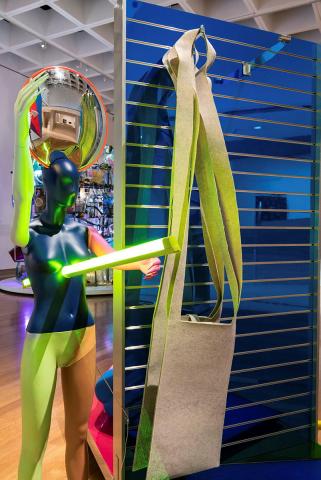
Hepworth’s Hole 2021
- WILLIAMS, Justene - Creator