PICASSO 2015.013
By Nina Miall
February 2026
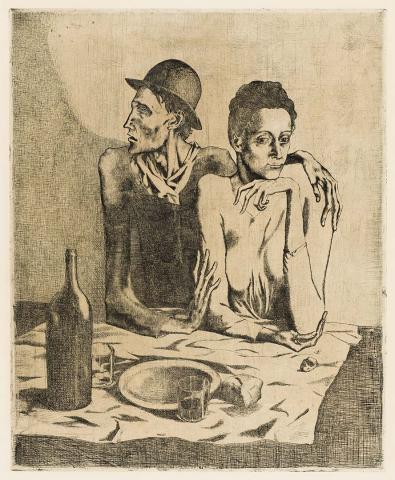
Le repas frugal (The frugal meal) marks Picasso’s first significant venture into printmaking and is today widely regarded as the final great work of his 'Blue' period. It portrays a sombre scene in which a pair of saltimbanques share a modest meal of bread and wine. Their elongated, entwined limbs imply a bond formed through shared hardship, yet the couple seem emotionally remote; their hollow faces and rigid postures contrast sharply with the vivacity typically associated with the circus. The influence of sixteenth-century Spanish master El Greco is evident in the figures’ attenuated forms; Picasso also looks to French artist Toulouse-Lautrec’s portrayals of quotidian Paris life. These qualities suggest the work denotes a bridge between the artist’s Spanish past and his French future.
Picasso originally turned to printmaking for its commercial potential; financial strain even prompted him to reuse a zinc plate that previously held a landscape by Joan González (1868–1908), a fellow Spanish artist living in the Bateau-Lavoir. However, the plate was not fully scraped down beforehand, and faint traces of González’s work are visible as tufts of grass in this image’s upper-right corner.