PICASSO 2015.014
By Nina Miall
February 2026
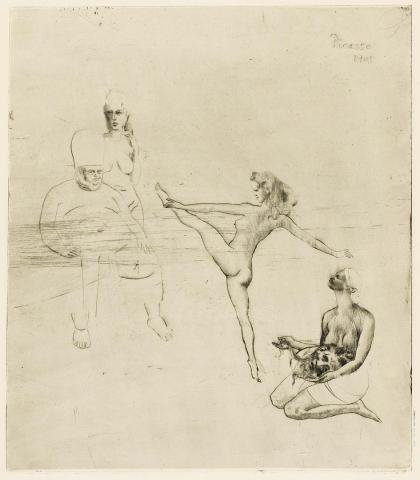
Salomé reveals Picasso’s interest in mythology and sexually explicit imagery, both of which would remain lifelong artistic preoccupations. In this retelling of the New Testament story, a nude Salome kicks her leg in the air, exposing herself before her seated stepfather, Herod, in an effort to persuade him to behead John the Baptist, who has spoken out against her mother’s marriage to the king.
The figure depicting Herod appears repeatedly in Picasso’s paintings, drawings and prints from the period. He was reportedly modelled on a circus performer known as El Tío Pepe Don José (though other historians have drawn parallels with Picasso’s poet friend Guillaume Apollinaire). Salome’s mother stands behind her husband, while a kneeling servant holds the decapitated head of John the Baptist, revealing the tale’s grisly end.
Although Salomé is unusual among the saltimbanque works for its Biblical subject, the print’s spartan composition, delicate draughtsmanship and circus references are consistent with the series’ recurrent themes. The appearance of Salome in Picasso’s work offers a further link to Apollinaire, whose poem Salomé appeared in the journal Vers et Poems in 1905. The artist certainly felt a kinship with Apollinaire’s poetic imagination during this period, and their artistic influences were closely entwined.