PICASSO 2022.177
By Nina Miall
February 2026
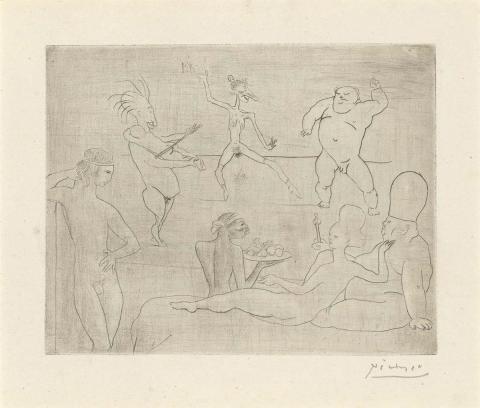
La danse barbare (Devant Salomé et Hérode) (The barbarous dance [In front of Salome and Herod]) is markedly different in style and tone from the other saltimbanque images, appearing more like a cartoon or private doodle. It is the second work in the series to explore the Biblical story of Salome who, at her mother’s request, demanded the head of John the Baptist at her stepfather Herod Antipas’s birthday celebration. Picasso was one of many writers and artists, including Oscar Wilde in his 1891 play Salomé, who evolved the image of the Jewish princess from spiteful daughter to cunning seductress.
In La danse barbare, the artist reimagines the story as a circus scene, with a corpulent Herod as jester and Salome as an acrobat, her reclined posture mirroring French painter Jean-Auguste-Dominique Ingres’s Grande Odalisque of 1814 (Musée du Louvre, Paris). The pair are surrounded by a coterie of acrobats, musicians and clowns, developed from satirical sketches of actors that the young Picasso did during his 1905 summer holiday in Holland (the same trip in which he painted La Belle Hollandaise 1905). Lacking elegance or grace, these caricatured figures are engaged in a disconnected, almost grotesque dance. (In one passage, a stout man runs a violin bow over the naked buttocks of the child resting on his shoulder.)