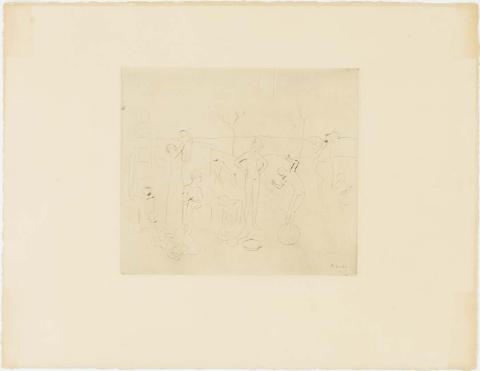
PICASSO 1992.011
By Nina Miall
February 2026
The French saltimbanque derives from the Italian word saltimbanco, which translates literally as ‘one who jumps on a bench’. Figures of hope and melancholy, these déclassé street entertainers inspired many artists and writers of the time, who felt an affinity with the performers’ lives of creative freedom and financial precarity.
Picasso attributes his interest in the saltimbanques to an encounter with an acrobatic troupe in the Esplanade des Invalides in Paris in 1904. However, it was only when he began to regularly attend the Médrano Circus that a deep enchantment took hold. An ambitious year-long project exploring the mythology and iconography of the travelling circus performers, working feverishly in sketches, studies, prints and paintings, culminated in the highly acclaimed canvas Family of Saltimbanques 1905 (National Gallery of Art, Washington DC), considered the masterpiece of Picasso’s Rose period.
The composition of this print summarises all of Picasso’s saltimbanque motifs. Its influence was so instrumental to Family of Saltimbanques that one impression even includes the squaring-off lines he used to transfer the composition from paper to canvas. Several vignettes move beyond a depiction of the circus performers’ everyday routines to assume allegorical significance; the female figures, for instance, present an unfolding drama of the various stages of life, from pregnancy and motherhood to advanced age.