PICASSO 2017.411
By Nina Miall
February 2026
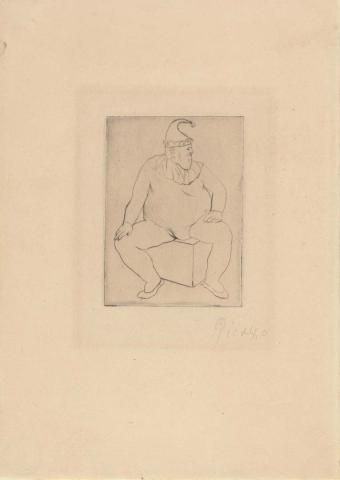
Le saltimbanque au repos (Seated acrobat) stands apart as one of the most understated and restrained of Picasso’s saltimbanque prints and a masterwork of the drypoint technique. Using contour lines of varying thickness and a few areas of minimal shading, the artist deftly captures this jolly and corpulent figure, giving him a paradoxical lightness that complements his role as a clown.
A rotund jester appears frequently in Picasso’s paintings, drawings and prints from the period, and doubles as King Herod in the Salome-related works in the suite. The deliberate blending of different characters and roles supports the theory that, considered collectively, ‘La Suite des Saltimbanques’ not only encompasses portraits of actual performers but also operates as a grand allegory of Picasso’s artistic circle at the time. Several scholars have noted the resemblance of the seated acrobat to his dear friend, poet Guillaume Apollinaire. Both men were immigrants, known for their quick wit and avant-garde ideas, and shared an artistic vocabulary rich in narrative and in literary and mythological themes. However, in another work, Picasso identified the figure as El Tío Pepe Don José, most likely from the Médrano Circus. It may be that the figure draws from multiple points of inspiration.