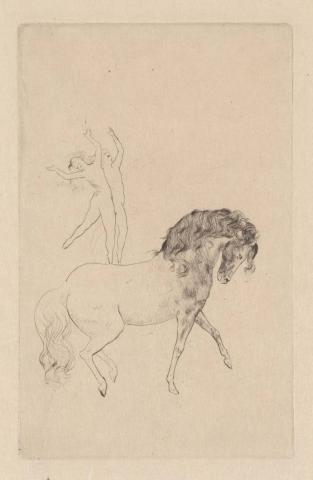
PICASSO 2020.001
By Nina Miall
February 2026
The famous Médrano Circus was located only a few streets from the ramshackle building – known as the ‘Bateau-Lavoir’ (‘washing boat’) for its resemblance to the rickety barges on the Seine – in which Picasso took up residence when he arrived in Paris. The artist was immediately drawn to its travelling circus performers, fascinated as much by their acrobatic routines as by their nomadic everyday lives. The many drawings, watercolours, gouaches and prints he made of the saltimbanques are emblematic of the kinship the immigrant artist felt with them as an artistic class living hand to mouth on the periphery of society.
The ninth print in the suite, Au cirque (At the circus) depicts a challenging feat – two acrobats, each balancing on the toes of one leg on a moving horse, their arms raised upward and heads flung back with bravado. The image displays an elegant economy of line, composed of only simple outlines except for the head, mane and front legs of the horse, which are delicately shaded in small hatches. Unlike other prints in the suite, Au cirque shows the saltimbanques performing their craft, rather than engaged in the activities of domestic life. One can imagine Picasso watching the pair as they practised their routine between performances.