PICASSO 2022.176
By Nina Miall
February 2026
Printmaking was a greatly productive avenue for Picasso and became one of his primary tools. He often explored the intimacy of prints – as he does throughout the portraits in the series – and appreciated the opportunities for sequential narrative and thematic investigation that the medium offered.
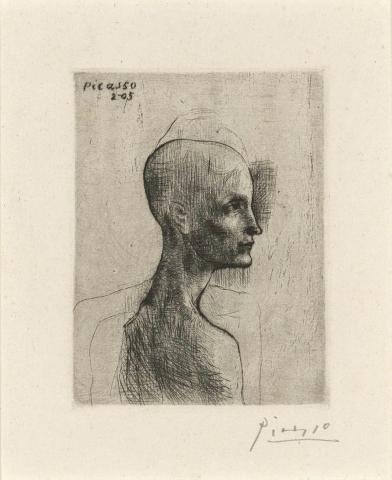
Buste d’homme (Head of a man) is an enigmatic image that appears to merge several viewpoints simultaneously, hinting at the cubist explorations Picasso would pursue in the next decade. The unnamed figure is rendered in profile; however, a faint frontal contour hovers above the body as a ghostly apparition. This outline is an earlier sketch left on the etching plate, showing a woman with her hair loosely tied up, reminiscent of Madeleine in Tête de femme: Madeleine 1907. A shadow cuts across the work, sculpting the figure’s torso, face and the wall behind him. The wall’s cross-hatching may have been intended to mask remnants of this earlier design; instead, it suggests a fleeting shadow that slips between the figure and the background. The resulting double image anticipates the spatial fragmentation and manipulation of his painting Les Demoiselles d’Avignon 1907 (Museum of Modern Art, New York), completed two years later.