PICASSO 2026.005
By Nina Miall
February 2026
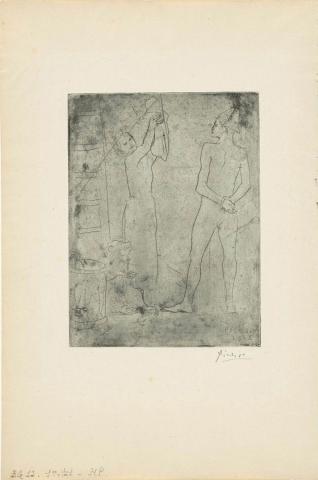
In this print, a mother lifts her infant with delight as the child’s father and a monkey look on affectionately. While the focus on family was not new for Picasso, this composition reveals how he progressively adapted the subject to suit the new expression and visual language of the Rose period. The scene’s gentle warmth connects it to several related works by Picasso, such as the painting The acrobat’s family with a monkey 1905, in the Göteborgs Konstmuseum (Gothenburg Museum of Art), Sweden. Variations in composition across the works mean the drypoint cannot be considered a preparatory sketch for the paintings; rather, each work stands alone, while together, they represent different approaches to a theme.
Picasso originally composed La famille de saltimbanques au macaque on a slightly damaged zinc plate, apparent here in the diagonal lines and blotches in the corners. Recycled plates often reveal ‘foul-biting’ – haphazard patterns made in the etching process, where unintended areas of the metal plate are accidentally etched with acid due to a compromise in the acid-resistant ground. When Vollard ordered the saltimbanque plates to be steel faced, the damage to this plate was exacerbated by that process. Vollard deemed the result unsaleable and retained only a small number of the impressions, making this version – printed by Fort prior to the steel-facing – exceptionally rare.