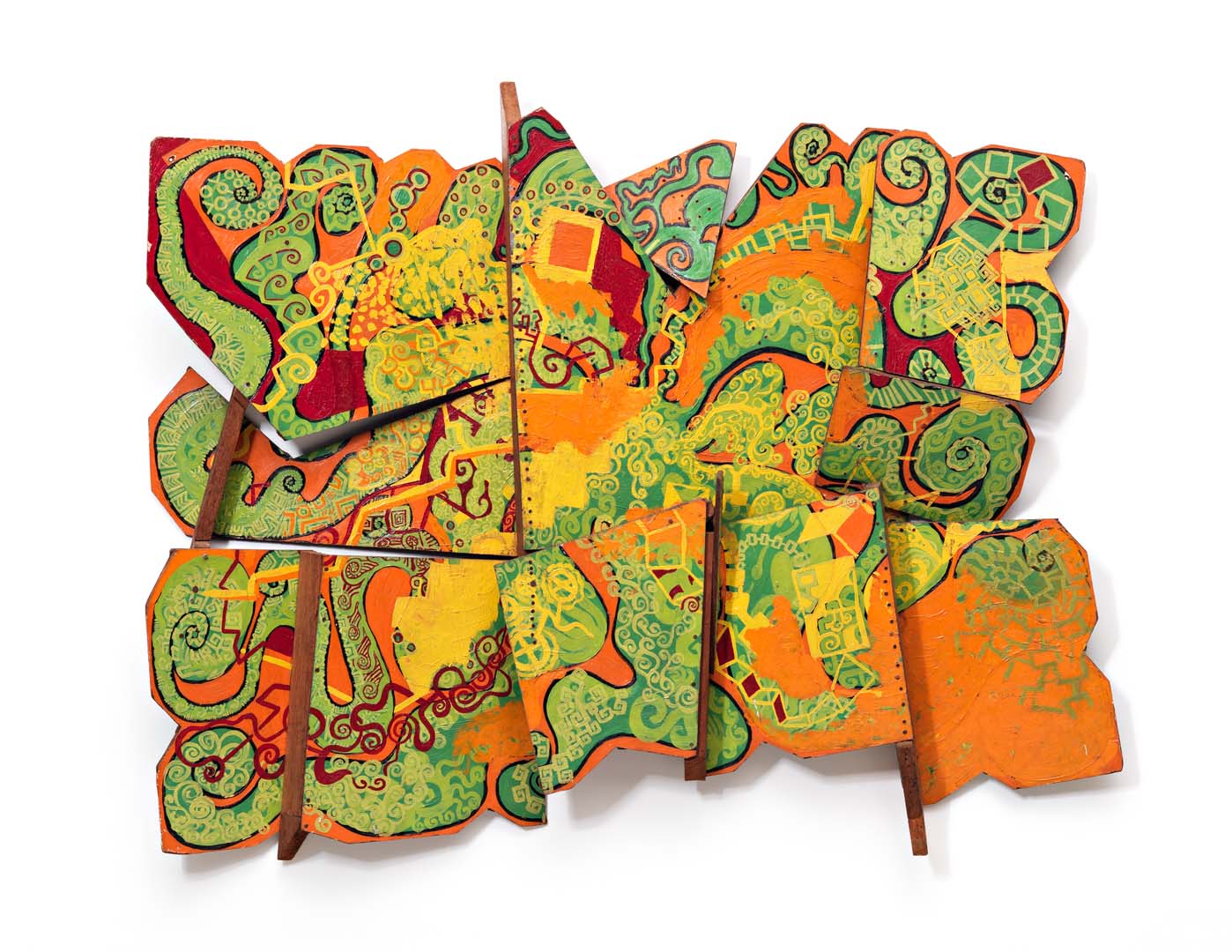
Orange flam is one of the works that launched Vivienne Binns’s career. Binns showed the artwork in 1967 in her first solo exhibition at Watters Gallery, Sydney, which included images of genitalia and paintings with irregular, unfinished surfaces. Binns was part of a group of Sydney artists who were influenced by Dada and Surrealism and used non-traditional materials, such as found objects, to challenge social mores. With her groundbreaking 1967 exhibition, Binns established herself as a leading avant-garde artist in Sydney, engaging with ideas of gender politics that would set the stage for her later explicitly feminist work.
While not as confronting as some pieces in Binn’s exhibition, Orange flam nevertheless contested conventional ideas of painting through its disjointed format and organic designs. In this way, Binns took a playful and defiant dig at contemporary artists, many of them male, working in the more refined, unemotional genre of hard-edge painting.
Sydney in the 1960s was in flux. Young, politically aware artists addressed sexual inequities and the parameters of art in ways that challenged mainstream society. Gallerist Frank Watters was pivotal in providing artists like Binns with a space to display and promote their work, despite criticism from conservative Sydney audiences.