The Baroque in 'Columns'
By Jacinta Giles
'Worlds within Worlds' March 2026
For Žilvinas Kempinas, like the Baroque artists before him, the classical column is a vehicle through which to express not only social concerns of the time but also a way to destabilise fixed perspectives. In Baroque architecture, columns were not merely balanced and orderly structural supports, as they had been in the Renaissance, but become instead expressive elements that could suggests worlds of infinity. Directing the viewer’s gaze ever upward, columns symbolised divine aspiration and the power of faith or the monarchy. Baroque columns – of which artist Gian Lorenzo Bernini’s St. Peter’s Baldachin 1623–34, in Vatican City, Rome, is the consummate example – are often spiralled or clustered, creating a sense of energy, rhythm and illusory space.
Kempinas’s contemporary Columns similarly transform this architectural feature into an immersive experience. Using magnetic video tape, he replaces marble solidity with fragility, raising questions about the spectre of technological obsolescence in a consumer-driven world perpetually seeking the new. This work engages light, space and the viewer’s own movement, echoing the Baroque fascination with optical play, ephemerality and spectacle. Like the artists and architects of the period, Kempinas means to manipulate the viewer’s perception: his columns appear to hover and dissolve, eroding the distinction between the viewer’s space and pictorial space.
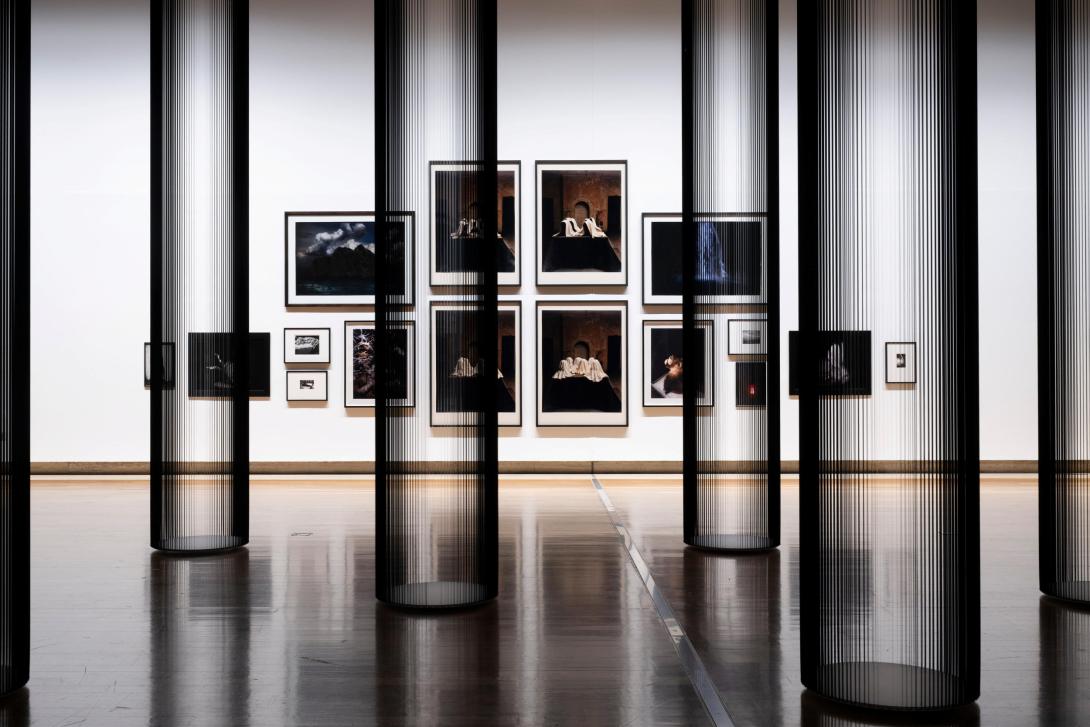
Žilvinas Kempinas's monumental Columns (detail) 2006, with a view of a salon hang including works by Gavin Hipkins, Anne Noble, Bill Henson, Justine Cooper, Imogen Cunningham, Anne Ferran and Laurence Aberhart installed for ‘Worlds within Worlds’, QAG, March 2026 / © The artists / Photograph: J Ruckli, QAGOMA
Curator's insight
Žilvinas Kempinas’s Columns 2006 not only embraces the Baroque’s destabilising of the Renaissance column, but can also be framed through the lens of the Baroque curtain.
Baroque artists treated curtains not merely as background decoration, but as elements of theatricality, drama and illusion.
Often drawing from the classical story of Zeuxis and Parrhasius – where a curtain was painted so realistically it fooled the eye – Baroque artists used drapes to blur the line between the viewer’s space and the painted world.
In Baroque art, curtains were often depicted as partially drawn back or caught in a wind, suggesting a moment of revelation – or a sudden, fleeting action – inviting the viewer to become a voyeur.
In walking through, or around, Kempinas’s Columns, they act as a curtain revealing the artworks on the surrounding walls.
Through the Columns, viewers see partial glimpses and alternative framings of the larger exhibition scene.
Written and spoken by Jacinta Giles (Assistant Curator, International Art), March 2026

Columns 2006
- KEMPINAS, Zilvinas - Creator