The Baroque in 'Siva in Motion'
By Jacinta Giles
'Worlds within Worlds' March 2026
Unlike the stillness of Renaissance art, the Baroque was fascinated with the idea of movement and how it could reflect a world in constant transformation. In this work Yuki Kihara, dressed as her alter-ego, Salome, has harnessed the power of movement to narrate the momentous seas that lashed Sāmoan beaches in Tsunami Galu Afi (2009), while also recalling the waves of change that hit the Sāmoan island over a century earlier in the form of European ships and Christianity. Kihara was inspired to create Salome, a late nineteenth-century Sāmoan woman, after seeing Samoan Half Caste – a photograph taken by Thomas Andrew in an 1886 album (held in the Museum of New Zealand Te Papa Tongarewa).
For Baroque artists such as Caravaggio and Gian Lorenzo Bernini, movement was expressed through gestures, flowing drapery and blurring the line between reality and art, creating a dynamic energy between time and space to overwhelm the viewer’s senses. Stop motion animation techniques slow Salome’s delicate fluttering hands, which draws us into this taualuga – a traditional Siva Sāmoa dance using graceful hand and arm gestures and performed by women of high rank. Kihara has also engaged time and space to create this moving-image work, stating that the work:
draws upon – and contributes to – the Sāmoan concepts of tā and vā: tā means to beat or to demarcate time through beats; while vā denotes the space between things or social space between people.
Suspended in time and space, Salome hovers somewhere between the real world and an otherworldly realm.
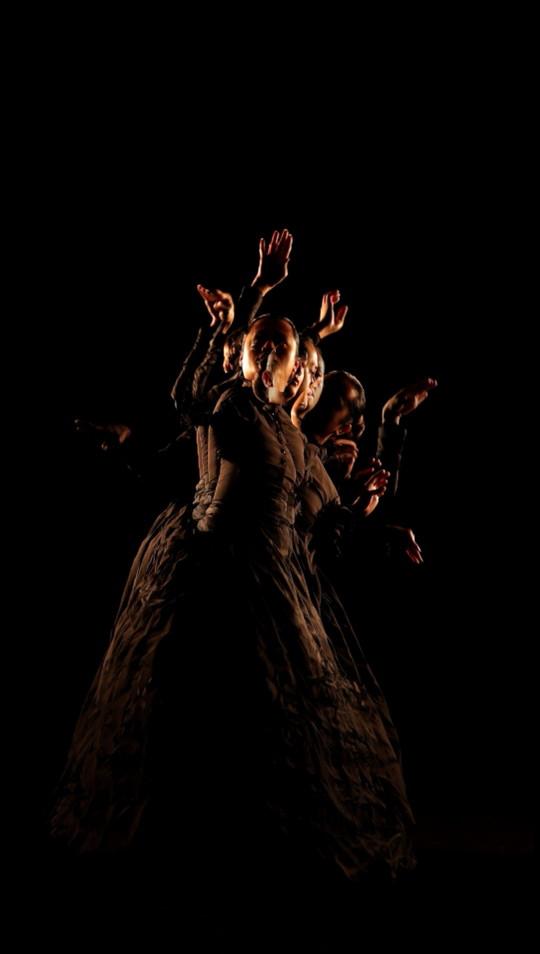
Yuki Kihara / Samoa b.1975 / Siva in Motion (still) 2012 / Single-channel HD video: 8:14 minutes, looped, colour, silent / Purchased 2015 with funds from Tim Fairfax AC through the QAGOMA Foundation / © Yuki Kihara
Curator's insight
The ‘unity of the arts’ – which is an intentional combining and integration of multiple artforms – was explored by numerous artists of the Baroque period, with Gian Lorenzo Bernini being the figure most often credited with realising the idea.
The concept’s intent was to create artworks that affected the viewer’s senses – in an overwhelming and emotionally charged way.
Bernini’s Ecstasy of Saint Teresa 1647–52 – which is housed in the church of Santa Maria della Vittoria in Rome – is the consummate example of this approach, with the artist combining architecture, sculpture, painted stucco and a hidden light source to create this unified religious drama.
Although Siva in Motion is a silent moving-image work, at first glance it emerges as a painting or photograph with Salome’s garments looking distinctly late nineteenth century.
With the work slowly moving – having been created through stop-motion techniques – it begins to develop as if three-dimensional, appearing more sculptural in format.
In combining the performativity of traditional dance, with historic two- and three-dimensional references, Siva in Motion’s timelessness anchors the viewer in a seductive otherworldly realm.
Written and spoken by Jacinta Giles (Assistant Curator, International Art), March 2026

Siva in Motion 2012
- KIHARA, Yuki - Creator