Curator's perspective: Riverbed
By Geraldine Kirrihi Barlow
'Presence' January 2026
Audio file
This installation transforms the gallery into an expansive rocky landscape, unfolding across the floor in every direction. Thousands of stones in shades of grey, black and brown cover the ground – from pale blue-grey pebbles to large, dark boulders – their varied tones contrasting sharply with the crisp white walls that frame the space. Gravel and sand settle between the stones, creating a textured surface that crunches underfoot.
From the work’s entry point, the rocky terrain rises gently upwards, as though sloping toward a hillside. Cutting through the stones is a narrow stream of flowing water. No wider than a few hand spans, it twists and bends across the slope, glistening as it catches the light. The stream emerges from an unseen source at the far end of the gallery, its water bubbling softly between the rocks as it winds downhill, finally gathering in a small reflective pool at the bottom of the incline.
The air is cool and still. The faint sound of trickling water can be heard nearby. There are no designated pathways through the work. Visitors are invited to step onto the uneven ground, choosing their own route across the stony surface. Our movements must be careful and deliberate, with each step shaped by the shifting stones.
Riverbed fills the gallery with the sensation of an expansive outdoor landscape, transforming the constructed space into a natural environment, dominated by rocky terrain animated by the presence of flowing water.
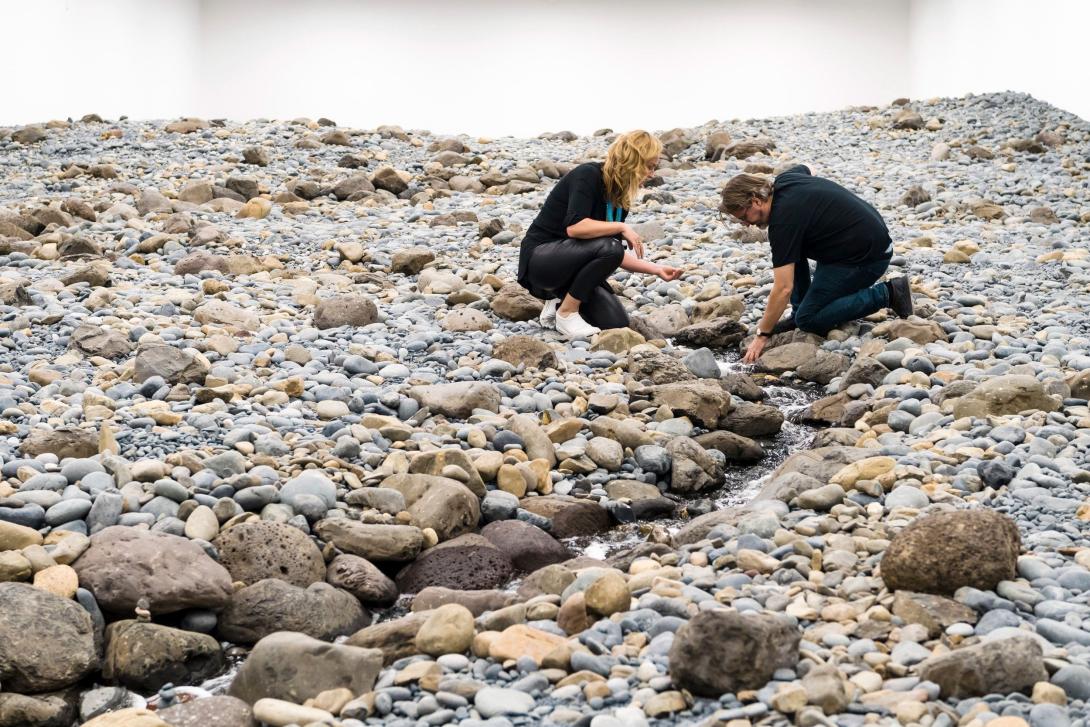
Olafur Eliasson / Denmark b.1967 / Riverbed 2014 / Water, rock (volcanic stones [blue basalt, basalt, lava], other stones, gravel, sand), wood, steel, plastic sheeting, hose, pumps / Purchased 2021. The Josephine Ulrick and Win Schubert Charitable Trust / Collection: The Josephine Ulrick and Win Schubert Charitable Trust, QAGOMA / Photograph: N Harth, QAGOMA
Listen and learn more
Audio file
Riverbed. The title of this artwork suggests the place where river comes to rest or lie down.
The river that we see here is small, it's like a little stream, a trickle as it winds and wends its way along a curved path from the top of the room above us and down below.
There are no trees or plants in this landscape. No birds, fish, or butterflies. The water itself gives a sense of animation, but there's no life here. Take a step inside, or take a seat, and just be in this space. Feel it. Think about it.
What does it remind you of? Perhaps a stream, perhaps a river that you've swum in. Imagine the waters rising, rising up to your ankles, your knees, your waist.
Is this space full of rocks? Or is it empty of water? A flood, that might be coming?
Australia is a landscape so shaped by flood and drought. For Olafur Riverbed speaks very much about Iceland. Imagine this river, this little stream, as the place where once the glacial streams have rushed by in the spring with great waves of water, then in summer perhaps retreating to this small flow. Great seasonal changes. A pattern, a cycle, which is changing. We've seen this earlier in the exhibition, in the Glacier melt series. As we look at the way that glaciers are retreating as the planet warms.
So, we can look at this artwork through the lens of our experience here in Brisbane, or use it as an opportunity to travel to Iceland, or perhaps use it as an opportunity to time travel. To think back to a time on our planet before life as we know it existed. Perhaps when the first streams of water began to move through rock and sand, perhaps microbes and early forms of life, develop communities and slowly live and work and compete together, to evolve into life as we know it.
Imagine the shifts of time, geological change, all sorts of events – perhaps comets or asteroids arriving from out of space – and again, reshaping life as it existed on earth.
Riverbed offers an opportunity to sit and reflect, to find our own path.
You'll see that Olafur doesn't create any specific path through the landscape, as with so many of his artworks. They're very psychological in this way. They ask us not only to make decisions, but to think about how we make decisions, the patterns of how we think and move and relate to each other. If you're visiting with a friend, and they walk in ahead of you, will you follow them? Or will you find your own path?
![Artwork Riverbed this artwork made of Water, rock (volcanic stones [blue basalt, basalt, lava], other stones, gravel, sand), wood, steel, plastic sheeting, hose, pumps, created in 2014-01-01](/system/files/styles/large/private/object-images/GOMA_Water_installationview_20191204_nharth_053.jpg?itok=23Pmu_Fu "© Riverbed, Olafur Eliasson")
Riverbed 2014
- ELIASSON, Olafur - Creator
Digital story context and navigation
Explore the story
'Olafur Eliasson: Presence'
Dec 2025 - Jul 2026