Heather Marie (Wunjarra) Koowootha: The struggle of spokes people
Heather Marie (Wunjarra) Koowootha
Wik-Mungkan and Yidinji/Djabugay peoples
Australia QLD b.1966
Heather Marie (Wunjarra) Koowootha was compelled to create an artwork that would teach her grandchildren and the younger generations about leaders who have shaped her Indigenous family, whose connections stretch from Innisfail to the Torres Strait. The result is The struggle of spokes people 2022, a series of portraits including educators and social justice advocates Evelyn Ruth Scott AO (1935–2017) and Gladys Tybingoompa (1946–2006); former Senator Neville Bonner AO (1922–99), the first Aboriginal Australian to become a Member of Federal Parliament; along with Indigenous land rights campaigner John Pampeya Koowarta (1940–91) – who happens to be the artist’s uncle.
These portraits of First Nations leaders are presented alongside an image of former Queensland Premier Sir Joh Bjelke-Peterson (1911–2005), whose uncompromising conservatism has also impacted the lives of Indigenous peoples, though, as the artist suggests, ‘not for the better’. For Koowootha, it was important to include the full spectrum of political figures alongside a self-portrait to show how affairs of the state and social justice campaigns directly impact individuals.
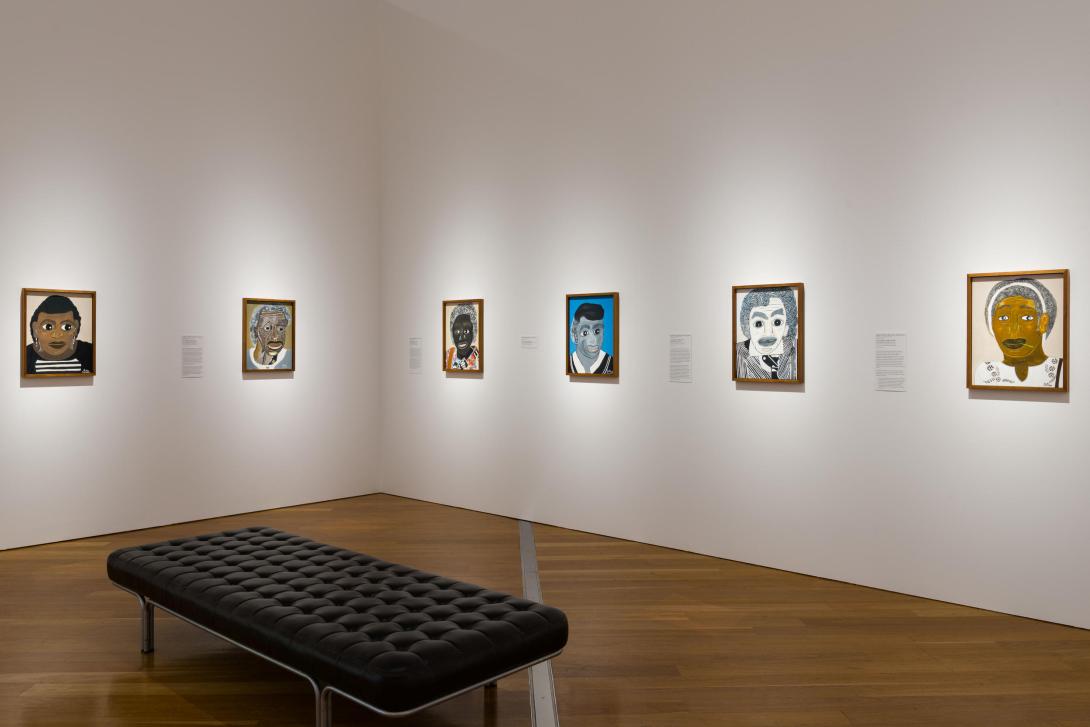
Heather Marie (Wunjarra) Koowootha's The struggle of spokes people 2022, installed at QAG for 'Embodied Knowledge', August 2022 / Purchased 2023 with funds raised through the QAGOMA Foundation Appeal /© Heather Koowootha / Photograph: N Harth, QAGOMA
The struggle of spokes people (John Pampeya Koowarta) 2022
John Pampeya Koowarta (1940–1991) was a Wik Elder, land-rights activist and the artist’s uncle. With other Traditional Owners and the support of the Aboriginal Land Fund Commission, Koowarta sought to acquire the rights to part of the Archer River Pastoral Holding in far north Queensland. The sale of this Queensland Government lease required the consent of the Minister for Lands, Forestry, National Parks, and Wildlife, who declined because of the buyers’ Aboriginal heritage. On the basis that the Minister’s decision contravened the Commonwealth’s Racial Discrimination Act 1975 the case was taken to the Supreme Court of Queensland. At the High Court of Australia, the Queensland Government did not succeed in arguing that the Racial Discrimination Act was invalid.
Although Koowarta won his case, the lease was cancelled by government and much of the land designated a national park. Koowarta’s case is considered an important legal precedent and paved the way for later land claims, including the first Mabo case in 1988. In 2012, the Oyala Thumotang National Park was symbolically handed back to the Wik-Mungkan, Southern Kaanju and Ayapathu Traditional Owners.
The struggle of spokes people (Gladys Tybingoompa) 2022
In a case that is commonly known as Wik vs Queensland 1996, the Wik People of Cape York Peninsula and the Thayorre People of South Cape York Peninsula successfully claimed in the High Court of Australia that native title coexists with state government pastoral leases. Prior to this case, governments had prioritised pastoralists’ rights in the Cape York Peninsula. It was important because the case recognised that Traditional Ownership was not extinguished by later claims over land since British colonisation.
Wik Elder, educator, claimant and the artist’s cousin Gladys Tybingoompa (1946–2006) was known as a strong leader and advocate during the trial. One of the most famous images from the case is of Tybingoompa performing a ceremonial dance in front of the High Court when the final decision was handed down, when she was quoted as saying: ‘My name is Gladys. I’m the hot one. The fire. Bushfire is my totem. And I’m a proud woman of Cape York today. It is for me, here today, a historic moment as a Wik woman. I am not afraid of anything.’
The struggle of spokes people (Neville Bonner AO) 2022
As a young man, the former Senator Neville Bonner AO (1922–1999) worked as a rural labourer across Queensland. In 1946, he was employed at the Palm Island Aboriginal Settlement and was a founding member of the Palm Island Social and Welfare Association. Moving to Ipswich in 1960, Bonner was active member and president (1968–1974) of the Coloured Welfare Council that later became the One People of Australia League. He became a member of the Liberal Party shortly after the 1967 referendum to count Aboriginal and Torres Strait Islander peoples as part of the national population and Commonwealth.
When appointed to the Senate in 1971, Bonner became the first Indigenous federal parliamentarian. He was the parliamentary representative on the Council of the Australian Institute of Aboriginal Studies, now the Australian Institute of Aboriginal and Torres Strait Islander Studies. After serving as a Queensland Liberal Senator for 12 years, Bonner resigned from the party in 1983 and narrowly missed regaining his seat as an independent in that year’s election. When asked about his greatest achievement in parliament, Bonner replied: ‘I think the fact that I was there. That an Aboriginal was there.’
The struggle of spokes people (Dr Evelyn Ruth Scott AO) 2022
A champion of education and social justice initiatives, Dr Evelyn Ruth Scott AO (1935–2017) was active in the Townsville Aboriginal and Torres Strait Islander Advancement League in the 1960s. She was a prominent campaigner for the 1967 Referendum that gave Aboriginal and Torres Strait Islander people the right to vote for the first time. Appointed in 1971, Scott was the first general-secretary of the Federal Council for the Advancement of Aboriginals and Torres Strait Islanders and through her endeavours the organisation became Indigenous-controlled in 1973.
Scott was also involved in the female-managed National Aboriginal and Islander Council in the 1970s. Serving as Chair of the Council for Aboriginal Reconciliation from 1997 to 2000, Scott stated:
We believe in a resolution of the national conscience that leads to a society where Aboriginal and Torres Strait Islander peoples and their cultures are respected and valued as the first peoples of this land and share in the nation’s wealth. This recognition should extend into our constitution and all institutions. We extend our hand to other Australians. Those Australians who take our hands are those that dare dream of an Australia that could be.