Ken Unsworth
By Emily Poore, Grace Jeremy
Artlines | 3-2025 | July 2025
Esteemed multidisciplinary artist Ken Unsworth is one of Australia’s most celebrated and accomplished contemporary practitioners. A new display at QAG brings together selected works by the artist — including paintings, sculptures and an installation — held in the QAGOMA Collection. Practising for more than six decades, Unsworth’s diverse works of art are both formally and conceptually ambitious, write curators Grace Jeremy and Emily Poore, often dealing with themes of transformation, human emotion and autobiography.

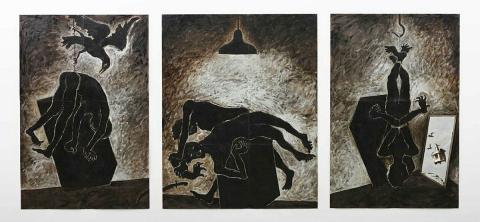
An installation view of ‘Ken Unsworth’, featuring Night rituals (no. 10 from ‘The mirror and other fables’ series) 1984 (Purchased 1996 with funds from an anonymous donor through the QAG Foundation); and Inverted stepped pyramid 1974 (Gift of the artist through the QAG Foundation 2024. Donated through the Australian Government’s Cultural Gifts Program), QAG, July 2025 / Photograph: N Umek, QAGOMA
Ken Unsworth’s artworks are recognisable for their poetic sensibility, material tension, and embodiment of the artist’s deep awareness of the human condition. Known for its clarity of insight and ability to plumb the darkest depths, Unsworth’s practice is philosophical and open-ended.
Unsworth is best known for his sculptural installations that dynamically engage with suspension and balance, often exploring the strength and capabilities of materials. In his Inverted Stepped Pyramid 1974, a structure of granite cubes hovers above the gallery floor, supported by dozens of thin steel rods that flow out from the pyramid and onto the floor like yarn or tentacles. The rods are so manipulated that they no longer read as steel, transforming an arrangement of everyday materials into an abstract depiction of gravity and motion. In Formation 1980 also places familiar elements in a seemingly precarious scenario, in one of Unsworth’s ‘most startling balancing acts’, in which three wing-like pieces of plywood temperamentally rest across thin steel rods leaning against the gallery wall.1 The uniformity of this work speaks to mathematical ideas of patterning and repetition, as well as natural formations like mountain ranges and birds in flight. Unsworth’s title echoes this in the dual reference to ‘information’ and ‘in formation’, a play on words reflecting the artist’s wit and sense of humour.2
Tension and balance are also at work in Suspended stone series – Stone circle II 1974–78 — a maquette of Unsworth’s larger installations of hung river stones. In this work, river stones hang from a steel cone, creating the illusion of being held in a forcefield. This gravity-defying effect is enhanced by a mirror that reflects the underside of the stones, and the conical shape of the support on which they appear delicately balanced. Unsworth’s use of ‘raw’ materials — which were not considered ‘traditional’ in artmaking at the time — was influenced by the work of Italian artists associated with the Arte Povera (literally, ‘poor art’) movement, who used natural and found objects in unconventional ways. By removing stones from their natural environment and re-presenting them as buoyant sculptural forms, the artist defies our expectations of their weighty material properties.

An installation view of ‘Ken Unsworth’ featuring Suspended stone series – Stone circle II 1974–78 (Gift of Simon Mordant AO and Catriona Mordant AM through the QAGOMA Foundation 2025. Donated through the Australian Government’s Cultural Gifts Program), QAG, July 2025 / Photograph: C Callistemon, QAGOMA
Though predominantly known for his sculptural work, Unsworth has also painted throughout his career. The dark content of his ‘The mirror and other fables’ series from the mid-1980s was inspired by twelfth-century Japanese scroll paintings of scenes of hell and suffering. The series also speaks to the parallels between Unsworth’s work and German expressionist painting throughout the twentieth century. The bitumen- and aluminium-based painting Night rituals — the tenth work in that series — shows a desolate landscape of inner turmoil. Painted in an expressionistic style using subterranean materials, it depicts scenes of brute force and psychological foreboding, containing tortured figures inspired by the gaki or ‘hungry ghosts’ Unsworth observed in the old Japanese scrolls. Their poses recall the artist’s riveting performances from the 1970s that saw him prop up and hang his own body in sculptural installations. As the artist has explained, ‘Night rituals perhaps expresses somewhat overtly and needlessly, an inner dreamlike landscape of inescapable conflicts and fears that border on erotic and sustaining neurosis’.3
This emotional intensity, combined with Unsworth’s creative approach to materials, can also be seen in his The flight of reason 1991, which brings together an eclectic mix of natural and household items to create a melancholic, dreamlike world. Across his practice, Unsworth embraces mystery, uncertainty and the subconscious to convey the inexplicable — an approach he shares with practitioners of dadaist, surrealist and symbolist art. Reason’s flight is represented in this work by objects gathered around a window frame: stones defying gravity, a whimsical dog figurine chasing them away, and a glowing lamp — perhaps a nod to the Enlightenment. Traditionally, windows symbolise truth: they provide a direct view of the world and represent the single viewpoint on which linear perspective depends. Unsworth interrupts this surety of vision by setting his window at an oblique angle. In his thwarting of the logic of everyday things, the artist gives his installation a strange, poetic atmosphere, creating a sense of wonder tinged with sadness.
‘Ken Unsworth’ offers a glimpse into his long-established practice and provides insights into the material inventiveness, emotional range and global influences at play in the work of this senior Australian artist.
Grace Jeremy and Dr Emily Poore are Assistant Curators, Australian Art.
'Ken Unsworth' is on display from July 2025 to February 2026 in the Watermall, QAG. To make the most of your visit, check the exhibition dates, get information on getting here and parking, and find out about Gallery accessibility.

Endnotes
- Anthony Bond, ‘Early sculptures and maquettes’, in Ken Unsworth, ARTAND Foundation, 2018, p.96.
- Bond, p.96.
- Ken Unsworth, Artist’s Statement, April 2001, QAGOMA Research Library.