Dr Getrude Langer's netsuke collection
By Tarun Nagesh
July 2015
This collection of netsuke was collected by Dr Gertrude Langer and purchased by the donor, John Riedel, after Dr Langer's death. The donor was a close friend of Dr Langer and wished to re-unite these objects with the large netsuke collection that the Gallery was bequeathed by Karl and Gertrude Langer in 1985 (Acc. 1985.028.001–063 and 1985.028.076–080). Dr Langer was the first qualified art historian to reside in Queensland, and was the president of the Queensland Art Gallery Art Society in 1965–66 and 1974–75; the Queensland President of the Arts Council of Australia for 14 years; and an art critic for the Courier-Mail.
The Japanese fashion of carrying elegant objects on one's person developed in the early seventeenth century. They were worn primarily on the obi (sash or belt), with early fasteners taking the form of an ivory ring, which then developed into the first manju netsuke, which were round and lightweight. The popularity of netsuke rose in the early eighteenth century, as tobacco pouches for smoking became an established custom. Throughout the eighteenth century, master netsuke carvers were largely commissioned by the imperial courts and wealthy samurai class. By the early nineteenth century, the craft had reached a highly sophisticated level, with netsuke of great quality being made in both Kyoto and Edo (now Tokyo). Netsuke hung over the top of the obi, securing the himo (cord) that ran behind it. Below the obi, an ojime (bead or fastener) would secure the himo to the top of a sagemono (an object that hangs from an obi). Sagemono could include money pouches, tobacco pouches, seal and ink containers, and the multi-compartment medicine containers known as inro, which, like netsuke, were finely crafted to feature detailed motifs in inlaid lacquer, ivory and wood.
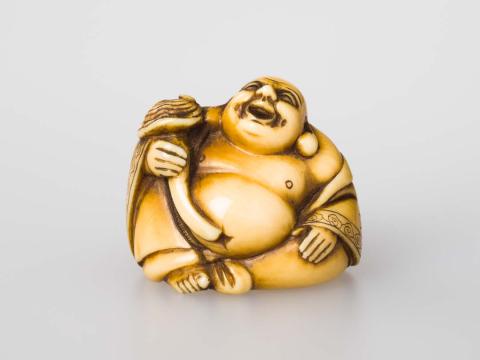
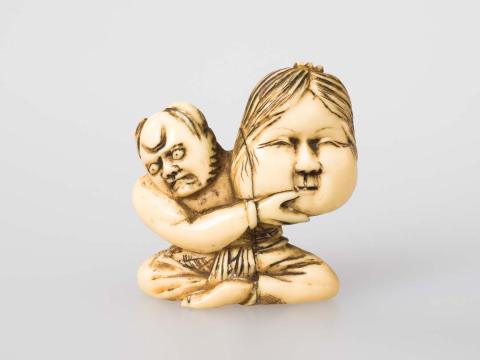
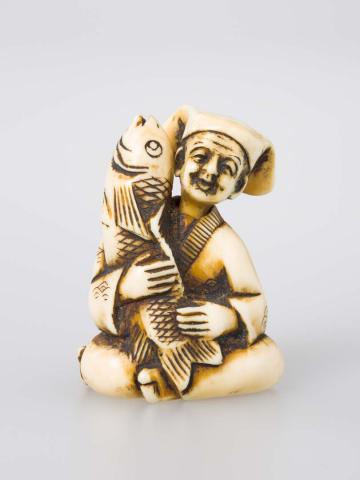
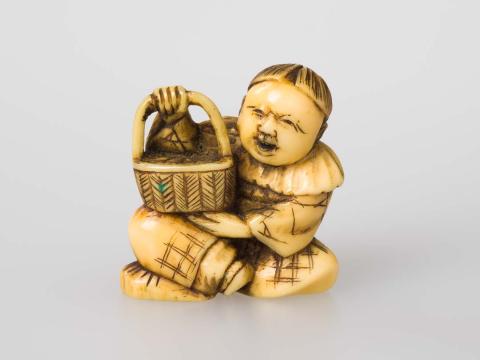
Netsuke epitomise several important aspects of Japanese art and culture, and demonstrate why it has fascinated people around the world since the country opened up in the 1860s. The attention given to this humble accessory reflects the preciousness of everyday objects. They express the refinement of traditional carving techniques and understanding of material, as well as the unique and exotic imaginations of Japanese artists in portraying the mythical, the spiritual, the grotesque, the customary and the natural. This collection shows a great diversity in subjects depicted in netsuke, and common figures and motifs of Japanese art. Several examples depict the Seven Lucky Gods or Seven Gods of Fortune ('Shichi Fukujin'), including Hotei, Ebisu, Fukurokuju and Jurojin. Also featured are a number of oni (demons/devils), as well as subjects drawn from nature, and an intriguing garden carved into the interior of an open clam.
Netsuke and other Japanese crafts were highly sought after in pre-war Europe, as detailed in Edmund de Waal's 2010 book The Hare with Amber Eyes. De Waal describes his Jewish family's prized collection of netsuke being collected in Paris, travelling with them across Europe, and then displaced as the family fled war-torn Austria in the 1930s. This collection may have taken a similar journey: collected in Vienna by Dr Gertrude Langer, they were brought to Australia after Hitler's annexation of Austria in 1938.
Connected objects

Netsuke: (Ebisu) 19th century
- UNKNOWN - Creator

Netsuke: (Hotei) 19th century
- UNKNOWN - Creator

Netsuke: (figure) 19th century
- UNKNOWN - Creator

Netsuke: (Fukurokuju) 19th century
- UNKNOWN - Creator
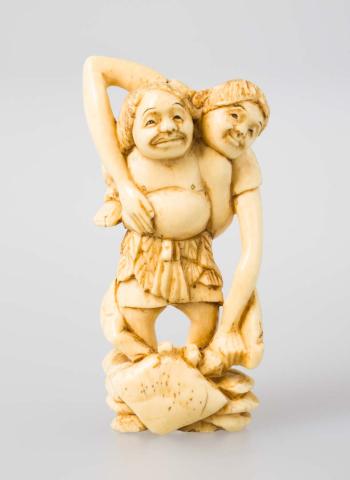

Netsuke: (Daikoku) 19th century
- UNKNOWN - Creator
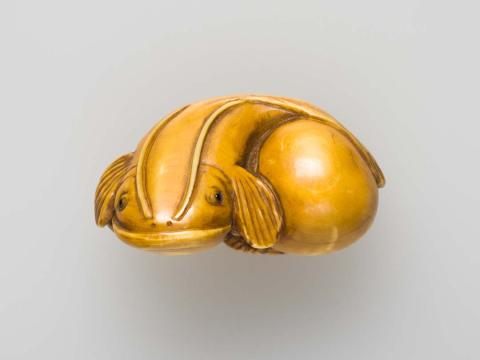
Netsuke: (catfish) 19th century
- UNKNOWN - Creator

Netsuke: (Fukurokuju) 19th century
- UNKNOWN - Creator
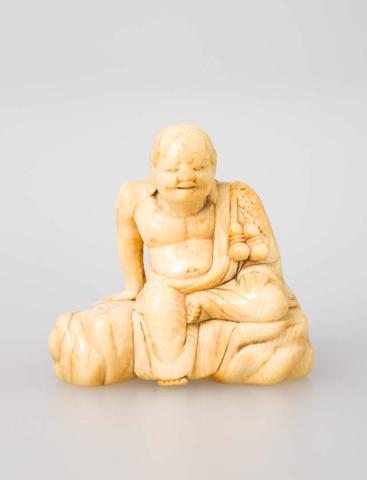
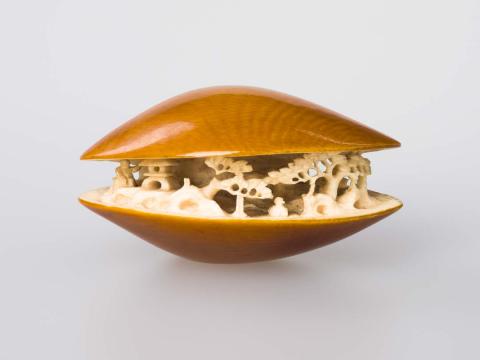

Netsuke: (Oni) 19th century
- UNKNOWN - Creator
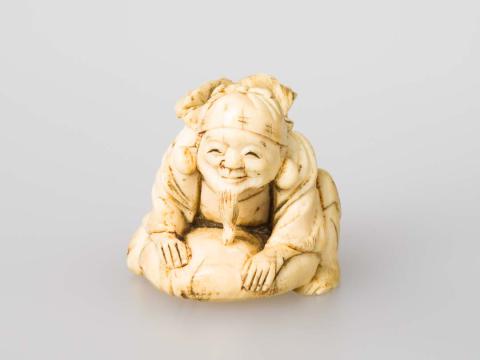
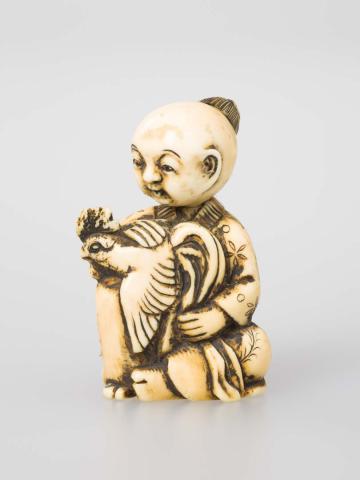
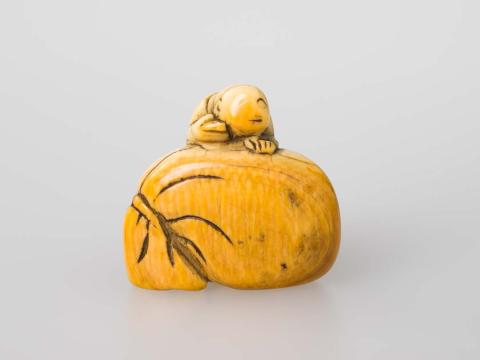
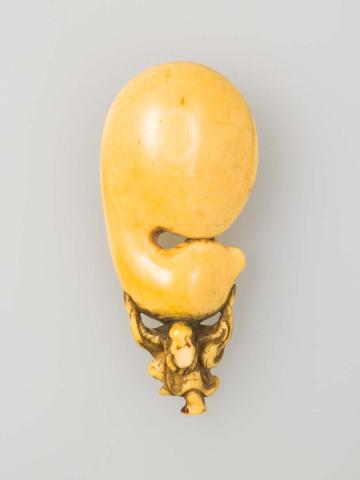

Netsuke: (bell) 19th century
- UNKNOWN - Creator

Netsuke: (stamps) 19th century
- UNKNOWN - Creator

Netsuke: (flower) 19th century
- UNKNOWN - Creator

Netsuke: (lotus bud) 19th century
- UNKNOWN - Creator

Netsuke: (Jurojin) 19th century
- UNKNOWN - Creator