Chinoiserie
Chinoiserie is a term denoting a style of European design showing Chinese or pseudo-Chinese figures and ornamental motifs. The term is most often applied to decorative arts produced from the second half of the seventeenth century to the early nineteenth century, when early trading contacts between Europe and East Asia were at their height. Key to the creation of chinoiserie was German manufacturer Meissen. Founded by Elector Augustus the Strong of Saxony (reg.1694–1733), at Meissen (near Dresden) in 1710, it is the oldest porcelain factory in Europe and the first to produce ‘true’ or hard-paste porcelain. The private collection of Chinese and Japanese porcelain amassed in the ‘Japanese Place’ in Dresden by Augustus the Strong became one of the largest and most important in Northern Europe, and much of the porcelain produced at Meissen copied or was directly influenced by this collection. With the appointment in 1720 of the painter and colour chemist Johann Gregorius Höroldt (1696–1775), Meissen began to artfully copy East Asian decoration and adapt it to European taste. Höroldt’s fanciful scenes of Chinese life, so-called ‘Höroldt chinoiseries’, had a decisive influence European design for over a century.
Connected objects

Plate, decorated with blue and white chinoiserie design c.1765-74
- MEISSEN - Manufacturer
- MÖBIUS, Carl Johann - Painter
- HÖROLDT, after Johann Gregorius - Designer
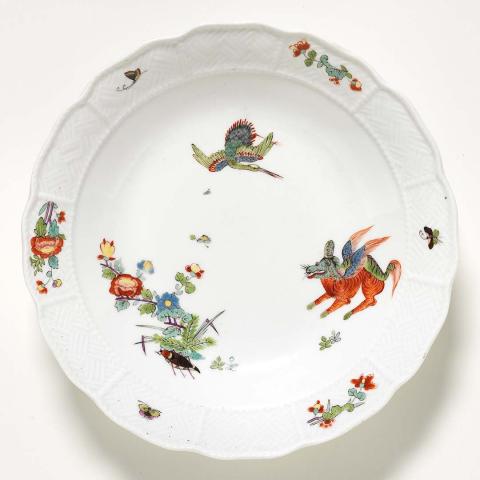

Lobed plate
- MEISSEN - Creator

Pair of ewers: Earth and air c.1850s
- MEISSEN - Manufacturer
- KAENDLER, after J.J. - Modeller

Plaque c.1870s
- MEISSEN - Creator

Monkey musicians (conductor and violin, trumpet, flute and cello players) c.1850-1900
- MEISSEN - Manufacturer
- KAENDLER, after J.J. - Modeller

Table c.1880-1900
- MEISSEN - Creator

Kylix shaped cup and saucer c.1900
- MEISSEN - Creator

Triangular dishes c.1850-1900
- MEISSEN - Creator

Sculpture: The tailor on the he-goat 1737, cast c.1850
- KAENDLER, J.J. - Modeller
- MEISSEN - Manufacturer

Cup and saucer (fluted) c.1800-50
- MEISSEN - Creator