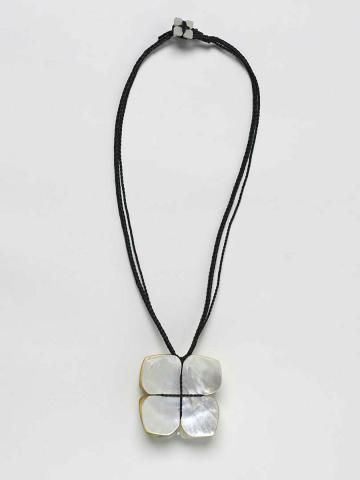
Sofia Tekela-Smith: 'Lovely hula hands' series
By Maud Page
October 2002
Sofia Tekela-Smith comments that 'self-decoration/body adornment is universal. I'm interested in the aesthetic of self-ornamentation and the idea that jewellery forms a complex of signs/symbols that amount to a visual language-feast'.1 Born in 1970, Tekela-Smith is a contemporary body adorner, born and based in Auckland, Aotearoa New Zealand. Her bold pieces and the practices involved in their execution are this artist's way of maintaining a link to her Island upbringing. Tekela-Smith transposes the knotting of natural fibres to plastics; sometimes affixing black pearls, she threads diridamu seeds into chokers, influenced by the fashion of Christian Dior. Constructing coconut and feather armour, Tekela-Smith builds her Island space through the thoughts associated with her threading, beading and carving.
Tekela-Smith has exhibited extensively in Aotearoa New Zealand as well as in Australia, New Caledonia and Fiji. She held a solo exhibition at the Mori Gallery, Sydney, in 2002 and was included in the group exhibition 'Jewelled, Adornments from across the Pacific' at the Museum of New Zealand, Te Papa Tongarewa, Wellington, also in 2002. Her work is held in the public collections of the Auckland Art Gallery, Toi o Tamaki, Auckland and in the Museum of New Zealand, Te Papa Tongarewa, Wellington. Tekela-Smith's blended Rotuman, Futunan, Uvean and Scottish heritage provides her with a constant and rich source of inspiration. A practicing artist for the last decade, her work most often takes the form of a lei or necklace, although at times she has also created installations. Tekela-Smith is interested in more than simple aesthetics; her work has an intrinsic corporeality. The artist says of her practice: 'I was raised by my grandmother Mue Tekela on Rotuma. I create work which gratefully acknowledges and represents my connection with her. The materials I choose to work with are for me the most appropriate medium to reclaim and strengthen a cultural tie to my diverse heritage.'2
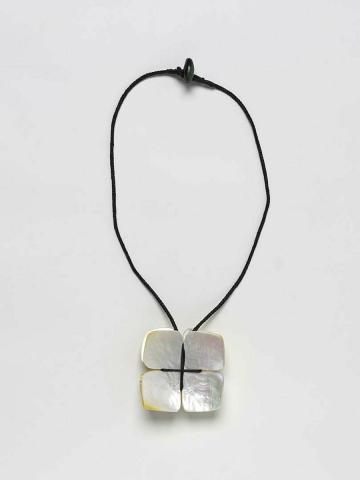
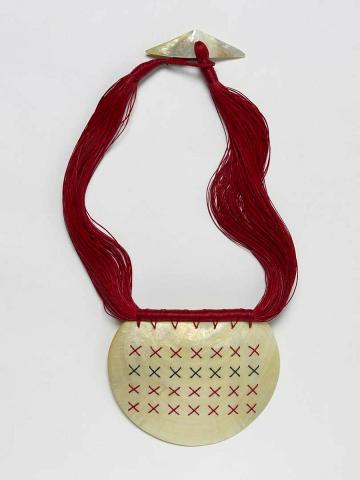
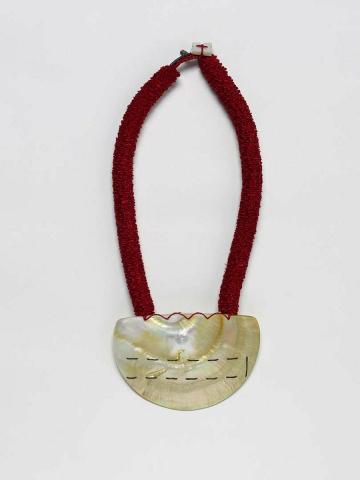
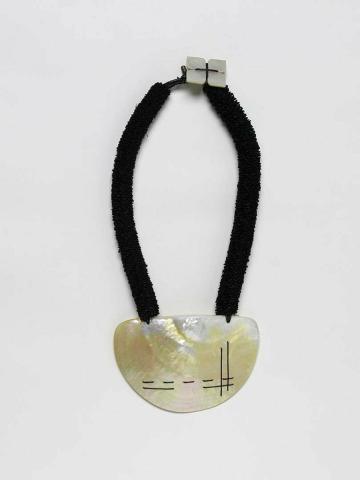
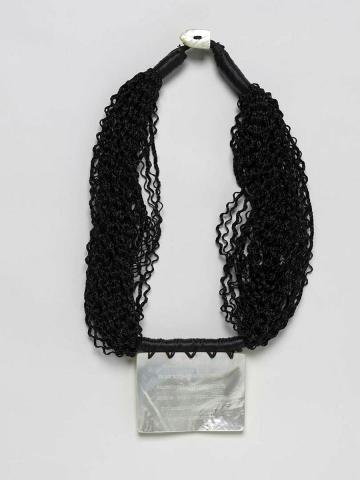
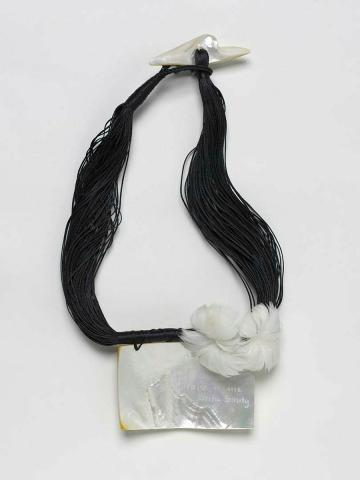
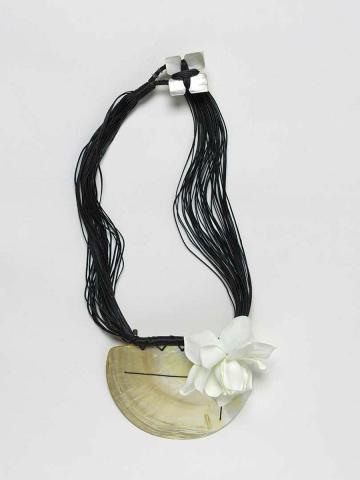
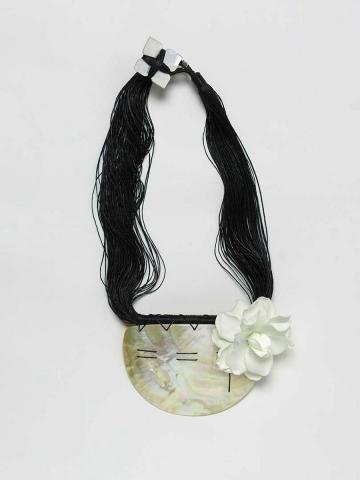
Tekela-Smith's works convey a unique sense of contemporary Polynesian culture. Materials such as diridamu seeds, greenstone, mother of pearl and coconut shell act as geographical signifiers, locating the works in the Pacific region. Tekela-Smith conceived of the 'Lovely hula hands' series during her visit to Hawaii in early 2002. The natural and opulent beauty of the island inspired her to develop works that explored the different ways in which mother of pearl could be combined with other materials, using the customary form of the breastplate. Throughout her practice this artist had aimed to make each work 'a tribute to the communication of harmony, beauty, strength and spirit'. The body-adornment works with mokuba ribbon have been constructed using a traditional Hawaiian lei- making technique, in which the ribbon is folded over itself in an intricate manner, consuming up to eighty metres of ribbon in the one work. Emphasising the cross-cultural connections in her work, Tekela-Smith readily tells the anecdote of how she was taught this technique by a group of female Japanese tourists that she met at a Hawaiian bus stop.3
Tekela-Smith's interest in body adornment directed her towards observing the different binding techniques employed across the Pacific. For example, much of the plaiting in the 'Lovely hula hands' series is an eight-plaiting technique used to create very strong string for lashing canoes and traditional dwellings. The artist has used a very simple but effective technique for working with fragile materials such as mother of pearl. With jewellers' tools she drills small holes in the shell, intertwining the waxed thread through. These threads are then singed at the back, creating a very neat and sturdy finish. The patterns are literally sewn onto the shell, building repetitious cross patterns or severe horizontal and vertical lines that accentuate the contemporaneity of the work. The sharp-edged lines are derived from Tekela-Smith's visits to Scotland, where she admired the slits within the stone walls of castles and appropriated the aesthetics into her own work. Equally personal are the bold, red and black crosses that feature in one of her works. These, she recounts, emerged from an early childhood memory of learning how to write 'between the lines'.4 Tekela-Smith's adaptation of mother of pearl into a breastplate is informed by traditional precedents. Before the twentieth century and the colonial influx into the Pacific, Rotuman and Fijian high-ranking chiefs wore pearl shell breastplates. It was recorded by Anglo-Saxon visitors to the island that these were braided with sennit, a plaited fibre often used on ships, and that they were so highly prized they were buried along with deceased chiefs. The breastplates were synonymous with rank in a manner that has not continued in contemporary times.5 Many of the historical breastplates were pillaged by Western colonialists and are now imprisoned in glass cases in anthropology museums across Europe. In her travels, Tekela-Smith always arranges to visit these depositories of Pacific culture, drawing on their beautiful designs and presence to create her own work.
The 'Lovely hula hands' series was created specifically for APT 2002 (APT4). Early discussions with the artist centred on how the work could be displayed in a manner that would reflect its vivacity, functional use and link with the body. The 'Pasifika Divas' performance event staged for APT 2002 was initially conceived in order to present the work of Pacific body adorners and designers in Aotearoa New Zealand. Tekela-Smith worked closely with the producer of the event, Lisa Taouma, and with the performers in order to create specific acts that would maximise the visibility and viewer engagement with her work.6 Sofia Tekela-Smith's work is a prime example of how contemporary Pacific artists are drawing not only on their rich and diverse past, but are also appropriating materials, ideas and aesthetics from across the world — giving their artworks new meaning and relevance.
Endnotes
- Sean Mallon and Pandora Fulimalo Pereira (eds), Pacific Art Niu Sila: the Pacific Dimension of Contemporary New Zealand Arts, Te Papa Press Wellington, Aotearoa New Zealand, 2002, p.44.
- Chris Charteris, '1 Noble Savage, 2 Dusky Maidens: Niki Hastings-McFall, Sofia Tekela-Smith, Chris Charteris', Judith Anderson Gallery, Auckland, Aotearoa New Zealand, 2000, p.31.
- Sofia Tekela-Smith, Conversation with Maud Page, 17 August 2002.
- Ibid.
- Alan Howard, 'Symbols of Power and Politics of Impotence: The Molmahao Rebellion on Rotuma' in Pacific Studies, vol. 15, no. 4, 1992, pp.83–116, http://www.hawaii.edu/oceanic/rotuma/os/ArtCrafts.html, downloaded 15 Aug. 2002.
- Documentation of this performance exists in video format, filmed and edited by Ben Wickes (Queensland Art Gallery research collection) and in photography by Lukas Davidson.