Baroque traditions: Tintoretto
By Jacinta Giles
'Worlds within Worlds' March 2026
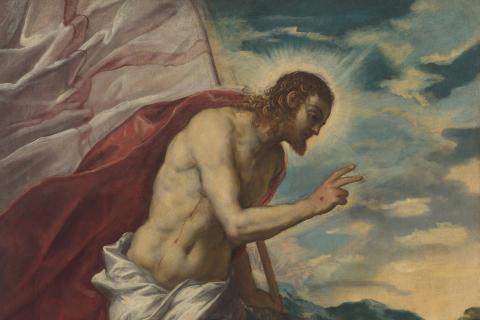
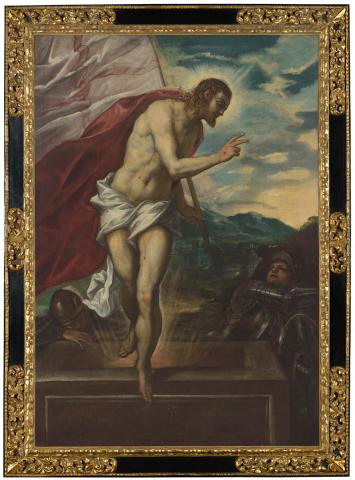
In Cristo risorgente (The risen Christ) c.1555, Italian Renaissance artist Tintoretto depicts Christ, triumphant over death. The figure of Christ holds the staff of the resurrection banner in one hand, while using the other to deliver a gesture of blessing or benediction to the awakening soldier.
During both the Renaissance and the Baroque, the Catholic Church was one of the primary patrons of art, commissioning works to convey religious messages, demonstrate power, and inspire devotion. While Renaissance artists created balanced compositions with clear perspective and idealised figures that depicted ‘divine beauty’, for Baroque artists it was the use of theatricality, dynamic movement, and intense emotion that enabled them to develop works that heightened the experience of religious spaces and guided worshipper’s faith.
Although the creation date of Cristo risorgente – believed to have been commissioned as church altarpiece – makes it Late Renaissance (also known as the Mannerism style), Tintoretto is often regarded as the father of Baroque art. Breaking from the harmony of the High Renaissance, the Mannerists sought to build on the greats before them – Leonardo da Vinci and Raphael, among others – by privileging compositional tension and instability over balance. Tintoretto’s canvases featured asymmetrical compositions, radical foreshortening, strong contrast between light and shadow, and almost cinematic scenes that blur the boundaries between reality and spiritual piety. His innovative fusion of sacred narrative and visceral emotion profoundly influenced later Baroque masters, such as Caravaggio, Deigo Velázquez and Peter Paul Rubens, making him a crucial precursor to the movement.
Connected objects
Digital Stories highlighting this narrative