Ingkwia Tjaiya, Lyaartinya Tjaiya (Old Way, New Way)
30 Years of Hermannsburg Pottery in the Collection
By Sophia Nampitjimpa Sambono
Artlines | 2-2025 | June 2025
A new display of ceramic works by artists from Ntaria (Hermannsburg) contributes to the Gallery’s ongoing project to make these distinctive works accessible worldwide and showcases a suite of newly commissioned pieces for the Collection. The Hermannsburg Potters, writes curator Sophia Sambono, see art as an avenue for self-expression in representing their culture, Country, history and lived experience.
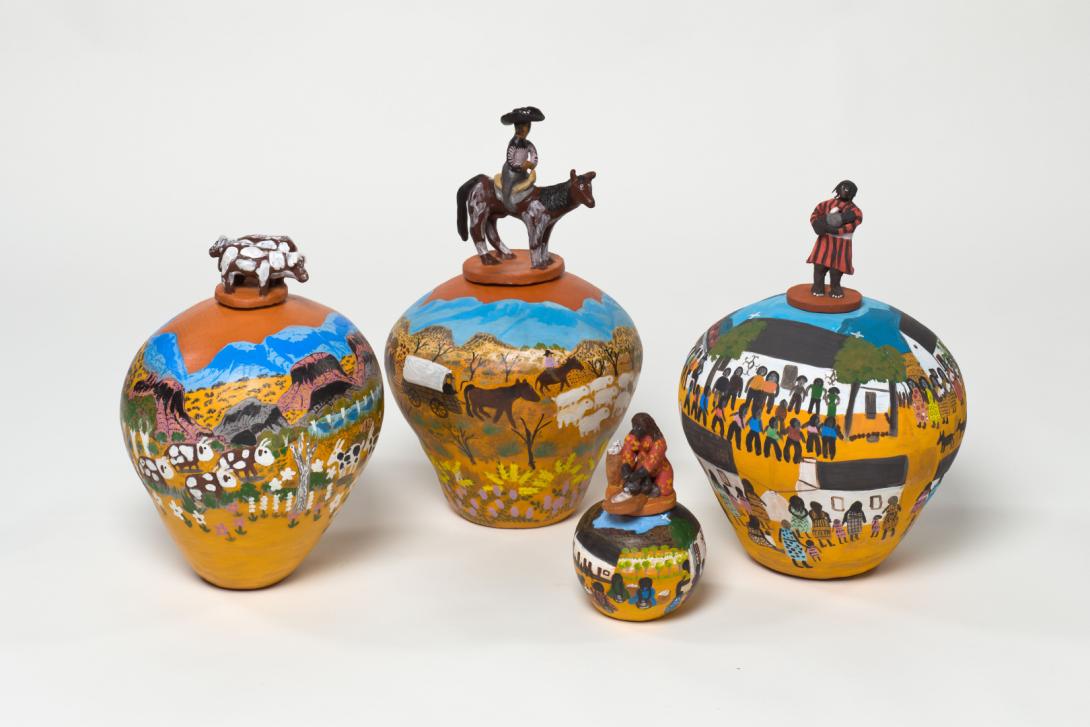
Earthenware pots by Irene Entata: Pot: Cows 2000; Pot: Reelpa (Drovers) 2002; Rubbing salts 2006; and Pot: Mission Days 2005 / © Irene Mbitjana Entata/Copyright Agency / Photograph: N Harth, QAGOMA
In the sweeping plains and red-hued rolling ranges of the Central Desert lies Ntaria (Hermannsburg), a former Lutheran mission about 130 kilometres west of Mparntwe (Alice Springs) and home to a dynamic, world‑acclaimed pottery movement. In the early ‘Mission Days’, Ntaria children were instructed in a variety of crafts, including modelling animals and figures from plasticine in the 1930s. By the 1970s, Barossa Valleyborn gardener Victor Jaensch (1911–78) assisted in expanding this practice. With the help of Aranda leaders Nahasson Ungwanaka and Joseph Rontji, Jaensch sourced local clay and taught the local men to produce small sculpted figures for the tourist market.1 Ungwanaka, as Pastor of the now independent Aboriginal community,2 remembered his clay building experiences fondly and, in 1990, lobbied for formal ceramics training for outstation families. Teacher-potter Naomi Sharp was soon appointed, and what began as a training program has since become an internationally renowned art movement, sustained by a dedicated group of women artists.3
Established in 1992 by Western Aranda community leaders as an economic venture, the Hermannsburg Pottery pioneered a distinctive style of hand-coiled clay vessels, often adorned with figurative, sculptural lids. The master ceramicists behind these works see art as an avenue for self-expression in representing their culture, Country, history and lived experiences in Ntaria and its surrounding outstations.
The hand-glazed panoramic landscapes depicted on the pots continue the legacy of legendary Arrernte watercolourist Albert Namatjira (1902–59). He expressed his deep connection to his Country in an adopted European pictorial style, embodying the sacredness of Tjoritja Country (the West MacDonnell Ranges) and altyerr (creation stories) within each painting. His success inspired his family and contemporaries to take up painting, going on to establish the enduring art movement of the Hermannsburg School of watercolour painting. The Hermannsburg Potters, historically mostly women artists, can trace their ancestry to Namatjira or to one of the other four family painting groups who were early practitioners of the Hermannsburg School style — Ebatarinja, Pareroultja and Raberaba — and continue to expand the tradition into three‑dimensional sculptural forms.
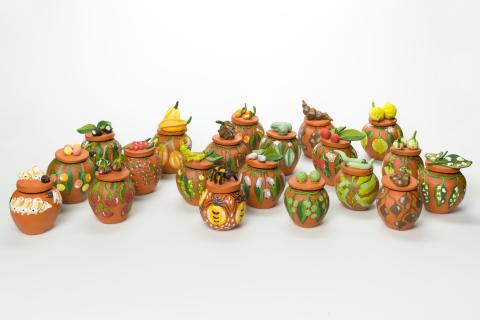
‘ingkwia tjaiya, lyaartinya tjaiya (old way, new way)’ is drawn from the Collection and features pots that immortalise Albert Namatjira’s journey to painting in the 1930s alongside depictions of early European contact or ‘Mission Days’, plant and animal altyerr, and contemporary desert life. The display spans artworks made in the 1990s through to today and highlights a suite of newly commissioned pots. These include a new generation of potters who acknowledge and honour the groundbreaking work of their mothers, grandmothers and Aunties while forging new styles and pathways of their own.
- See Jennifer Isaacs, Hermannsburg Potters: Aranda Artists of Central Australia, Draftsman House, Sydney, 2000, p.50.
- The mission was formally transferred to Aranda community ownership and governance in 1982 under the Aboriginal Land Right Act 1976.
- Drawn from the Hermannsburg Potters Aboriginal Corporation pamphlet Ntaria: Our Country, Our People, undated.
Sophia Nampitjimpa Sambono (Jingili people) is Associate Curator, Indigenous Australian Art.
Learn about the history of the Hermannsburg Pottery and explore the Gallery’s holdings through the Collection Online portal.
‘ingkwia tjaiya, lyaartinya tjaiya (old way, new way): 30 Years of Hermannsburg Pottery in the Collection’ is on display until October 2025 in the GOMA Foyer Cabinet. To make the most of your visit, check the exhibition dates, get information on getting here and parking, and find out about Gallery accessibility.
The Gallery gratefully acknowledges the hundreds of donors who generously supported the QAGOMA Foundation’s ‘Unlock the Collection’ campaign to digitise the Collection and make artworks more discoverable. The Hermannsburg Potters research project was made possible from funds from campaign donations.
Digital story context and navigation
Explore the story
'Ingkwia Tjaiya, Lyaartinya Tjaiya (Old Way, New Way)'
May 2025 - Nov 2025
