Pat Hoffie: I have loved/I love/I will love
selections from a series of prints made throughout 2024
By Pat Hoffie
‘I have loved/I love/I will love’ August 2025
To love. To be loved.
To never forget your own insignificance.
To never get used to the unspeakable violence and the vulgar disparity of life around you.
To seek joy in the saddest places.
To pursue beauty to its lair.
To never simplify what is complicated or complicate what is simple.
To respect strength, never power.
Above all, to watch.
To try and understand.
To never look away.
And never, never to forget.1
2024: Unending information keeps descending. Dust and damage. Disintegration. Broken buildings. Tiny broken bones. Holes in the earth where the dead now dance.
Far away, back here, images fug up our airways. Distort the transmission. Keep failing then falling and flowing into our drains. Stained substantiation of our collusion.
We’d been well-warned: phrases shaped long ago by writers facing their own sick-at-heartness. Words wrought from woe; lamentations and admonitions and faux incantations to avert the return of such tragedies. Yet it happens again and again. Once more, we move ‘between the sob and clubbing of the gunfire’, sad Slessor.2 Once again, ‘things fall apart’, sweet Achebe,3 grave Yeats.4 And this time, our daily plague congeals into new forms of hellish glamim, mangled and other.
Some iCloud data isn’t syncing.
The next day and the next, shadows from ‘the conflict’ cast shadows across our daily routines. This trauma. This collapse into globalised illness. At intervals, we take time to search for threads of sense amidst torn-apart bundles of innocence.
We creep forward. Blind-walk the tracks of our familiar habits. Pause to comb through the internet’s serve of detritus and dust-piles. Flick left. Flick left. Are left alone, lost beneath clouds of ash that hover. Grey wafers waft downwards, slipped from the knife-edge of an elsewhere wind.
You foreshadowed this, dear Eliot, this ‘fear in a handful of dust’.5 Yet now, no lilacs to grow in this dead ravaged land, this strip of crumpled hope.
Now buckled and broken, tumbled and torn, the gravity of the stars spins akimbo. The massacre of the innocents to feed these ruins. The stolen stele of the vultures. Torn monuments to gods and men turned to tombstones. And beneath, tiny toes and soft breathing. This, our new Waste Land, summons up renewed keening. McCarthy’s judge says that: ‘...war is the truest form of divination. … War is the ultimate game … War is god.’6 His whispers are too much to bear.
Verify your account information to resume syncing.
I pace out this penance.
As if memory might matter.
Work into the nights retracing images.
Cutting and scratching, rubbing and bruising and burnishing hallucinations into being.
Scraping together shavings from the voices of others.
Slim sustenance:
‘War begets war,’ said Butler. ‘It produces outraged and humiliated and furious people.’ 7
But her scholar’s words float thinly. Are blown away by the morning’s newsfeed. No call for exculpations. Your vultures preen and smile.
No apps using significant energy.
This magma of defencelessness spreading
The next day’s mournings every morning
pass into a history of forgetting.
‘We must become spies on behalf of justice,’ said Okri.8
I winnow for remnants of clues or truth from the words of the past. A threadbare archaeologist, raking through the grim remains for vestiges of prayers, for shards of hope.
Open Symantec Endpoint Protection.
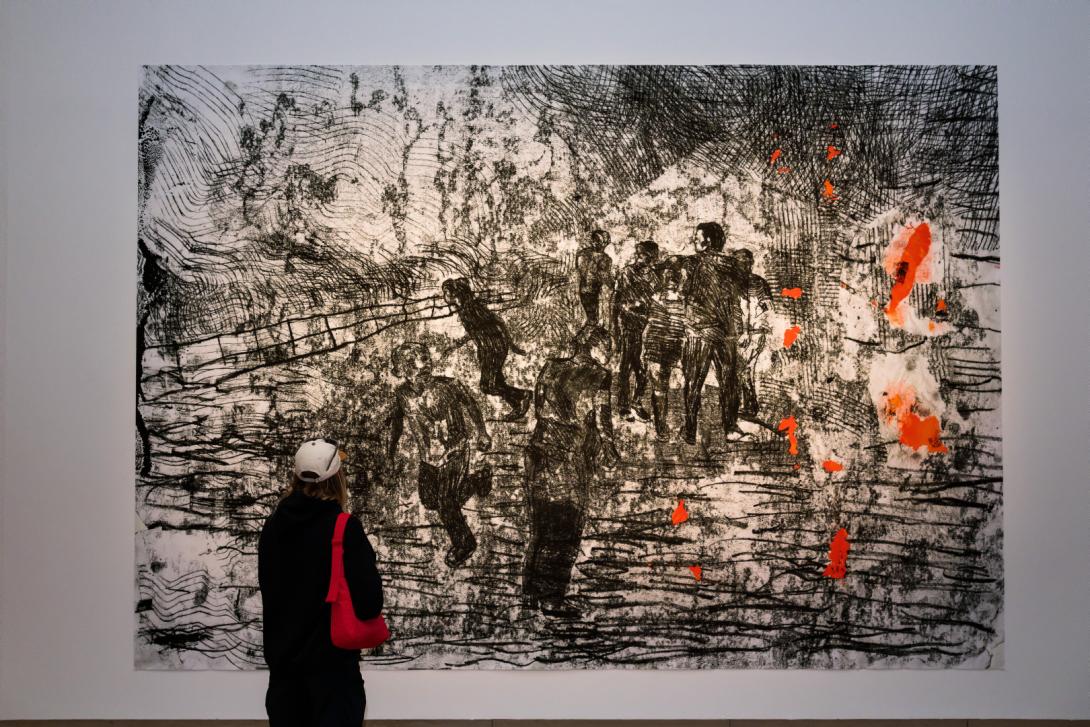
Image from Pat Hoffie’s ‘I have loved/I love/I will love’ 2025, installed in QAG's Gallery 14, August 2025 / Giclée print on paper / Courtesy and © Pat Hoffie / Photograph: K Bennett, QAGOMA
Foreword told after
In 2024, when I was first invited as artist-in-residence by Cobalt Editions Print Studios Director, Dr Tim Mosely, I arrived with another idea about what I might make. But long solitary hours spent working in the studios became steadily saturated by the deluge of accounts of overseas warfare that ran on relentlessly that year.
Descriptions of the conflict played out day after day, month after month. The incursions that arrived via iPhone, computer, TV screens were instantly disposable. Reuters. Al Jazeera. CNN. YouTube. ABC. BBC. NBC. The New York Times. Instagram. Unicef. Oxfam. The Guardian. On and on. And the next day delivered another slew. Then another. Till the growing pile of discarded fragments coagulated behind the retina to ooze down deep into everyday dreams.
I wanted to slow some of these images down. To decelerate them. To temporarily detain them. Though each of them shocked and sickened me, I could all-too-easily instantly forget them. And yet, it occurred to me, I had never been able to un-see a Goya.
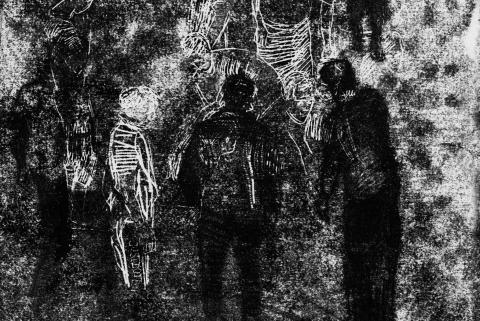
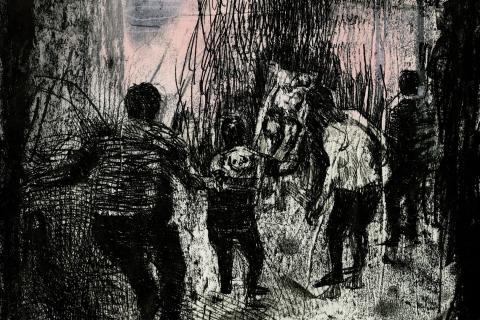
So I retraced those media-shadows into drypoints. Each part of the process seemed oddly appropriate. First, I cut and gouged them to produce a scarred substrate. Next, the prints materialised through processes of ‘suck and stain’ as the thick, black, oily slick of the ink was absorbed into the wet, scarred, fragile fibres of recycled paper. I worked in a state of ersatz somnambulism: pulling them from media-feeds to resurrect them into another state of being. Whenever the paper was peeled away from the plate, a surprising field of un-rehearsed marks and registrations came into play, as if the work had taken on its own role in coming into being. Inky black blobs invented relationships to which I was a stranger: tears and shards and smears ran through my ragged attempts at representation. Men reaching and children seeking. Women wailing. Figures bent at the task of searching for survivors. The world a broken matrix of ruined relationships.
This writing — this attempt to explain why this recourse to make art as some kind of response – is a grab-bag of gleaner’s gatherings. I return to the words of the writers. I return to the images of the artists. Callot. Goya. Dix. Kollwitz. So many.
My own tattered responses get snagged on the looping coils of Dannert wire that crisscross these zones of devastation. All wars petition for the taking of sides. All wars infect their witnesses and onlookers. The making of art, of dialogue, of discussion may be little more than an activity for ‘keeping one step ahead of the persecutor within.’9
Feeble materiel indeed.
And doubters are never alone. ‘Art never stopped a war,’ one sober friend chastened me. He was right. All artists are aware of the bruised futility of art’s faith. But my friend had forgotten the rest of Bernstein’s quote: ‘That was never its function … Art cannot change events. But it can change people.’10
Throughout history, from amidst other rubble and ruin, other crises of heartlessness and hopelessness, art has maintained its tiny persistent drive to dig down, to reach out and upwards, yearning for, calling out to those who have refused to abandon hope and love. Amidst this, yet another Holy Land, Wasted, it persists from a simple urge:
. . . to watch.
To try and understand.
To never look away.
And never, never to forget.1
Endnotes
1. Arundhati Roy, The Cost of Living, 1999.
2. Kenneth Slessor, ‘Beach Burial’, 1944.
3. Chinua Achebe, Things Fall Apart, 1958.
4. William Butler Yeats, ‘The Second Coming’, 1919.
5. TS Eliot, ‘The Waste Land‘, 1922.
6. Cormac McCarthy, Blood Meridian, or The Evening Redness in the West, 1985.
7. Judith Butler, Precarious Life: The Powers of Mourning and Violence, 2004.
8. Ben Okri, The Famished Road, 1991.
9. Bob Dylan, ‘Jokerman’, Infidels [album], 1983.
10. Leonard Bernstein, Findings, 1982.
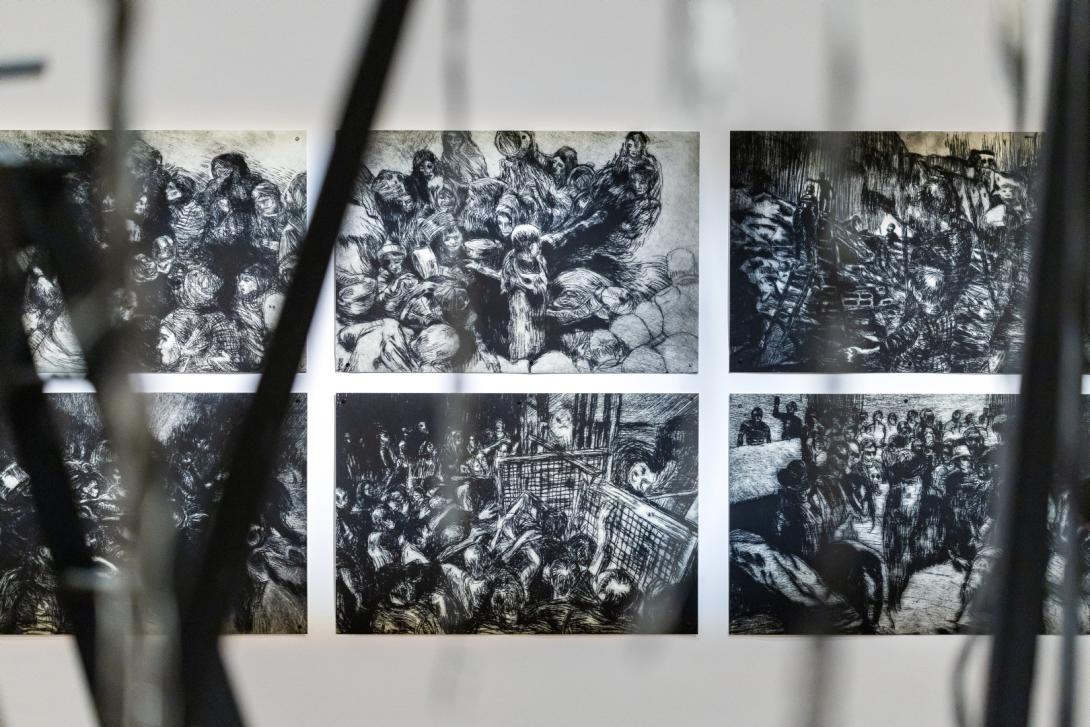
Works from ‘I have loved/I love/I will love’ 2025, installed in QAG's Gallery 14, August 2025 / Courtesy and © Pat Hoffie / Photograph: K Bennett, QAGOMA
In gratitude
None of this ever grows from within a vacuum. There’s never a solitary artist. There’s always a community. Always a family. Always a mob. Always those who keep the thing on track and, in the face of all kinds of odds, will it into being.
Nina and Tim walked beside these ideas and images each step of the way. Jorge, Jonathan, just kept giving and guiding. Grace picked up the project and steadied it back on course. Chris kept his consistent custodianship from the beginning to the end. I thank all of you involved in this: Tim Mosely, Nina White, Jorge Mariño Brito, Jonathan Tse, Grace Jeremy, Chris Saines, Peter McKay, Greg Hoy and Nathan Shepherdson, Ashley Hay and Ian Were for editing, and many others.
‘Pat Hoffie: I have loved/I love/I will love’ is on display in Gallery 14, QAG, from August 2025 to February 2026.
Explore ‘I have loved/I love/I will love’
Digital Story Introduction
I HAVE LOVED/I LOVE/I WILL LOVEPat Hoffie: Only scratching the surface
Read ARTIST'S STATEMENT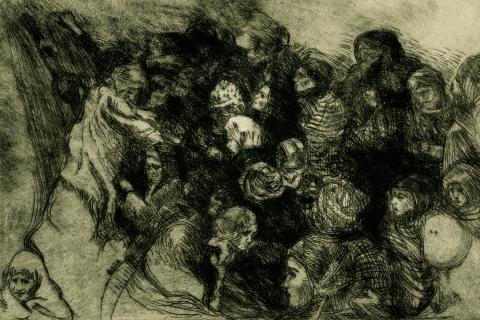
Digital Story Introduction
I HAVE LOVED/I LOVE/I WILL LOVEI have loved: Slowing down history
Read ESSAY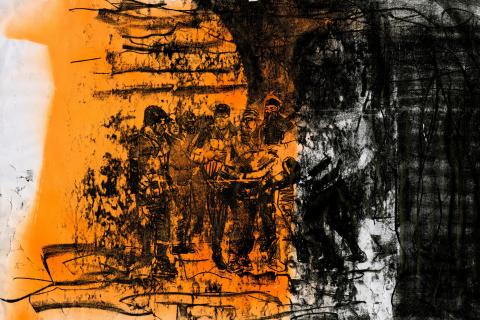
Digital Story Introduction
I HAVE LOVED/I LOVE/I WILL LOVEInk impressions: Pat Hoffie’s printmaking
Read INTERVIEWDigital story context and navigation
I HAVE LOVED/I LOVE/I WILL LOVEExplore the story
Digital Story Introduction
I HAVE LOVED/I LOVE/I WILL LOVEPat Hoffie: Only scratching the surface
Read ARTIST'S STATEMENT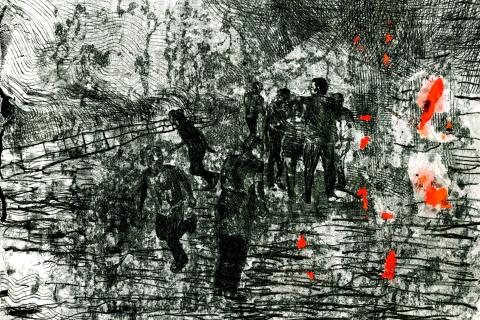
Digital Story Introduction
I HAVE LOVED/I LOVE/I WILL LOVEPat Hoffie: I have loved/I love/I will love
Read ESSAY
Digital Story Introduction
I HAVE LOVED/I LOVE/I WILL LOVEI have loved: Slowing down history
Read ESSAY
Digital Story Introduction
I HAVE LOVED/I LOVE/I WILL LOVEInk impressions: Pat Hoffie’s printmaking
Read INTERVIEW