Ink impressions: Pat Hoffie’s printmaking
By Pat Hoffie, Samantha Shellard
‘I have loved/I love/I will love’ August 2025
In early 2025, QAGOMA paper conservator Samantha Shellard met with Pat Hoffie at Griffith University’s print studios to discuss her printmaking ahead of the exhibition ‘I have loved/I love/I will love’. Here, they explore in-depth Hoffie’s recent foray into drypoint printmaking.
Printmaking has offered me ways to reconsider the extent to which the visual image might remain capable of still connecting with us in a deeper way. I’m still wondering whether visual art can retain its power to provoke complex questions, reflections and reconsiderations.
— Pat Hoffie, 2025
SAMANTHA SHELLARD: I am curious about why you have chosen specific processes. Can you describe the evolution of your work? What motivated you to choose large-format printing, and how has it enabled you to express your ideas?
PAT HOFFIE: Recently, I have considered how printing has influenced this current practice, which is the first time I have used analogue printing. My previous exposure with printing occurred in the early 1990s, when I participated in the Queensland Art Gallery exhibition called ‘Instant Imaging’, curated by Anne Kirker. Back then, I recognised how, throughout history, printing had disrupted ideas that lie at the core of artmaking, particularly how notions of authenticity, originality and how we perceive the hand of the artist are disrupted by the impact of seriality and limited editions. I explored this disruption when I received an artist residency with Canon Copiers, which allowed unlimited access to their colour laser copiers, where I could exploit their working properties. I produced a solo show called ‘Gender, Nature, Culture’, which explored femininity. Throughout history, print has revolutionised our questioning, shaping who we are and how we think. I was aware of the power of print media, but until last year, I had never had the opportunity to create in a traditional print studio.
SS: So, you knew how provocative prints could be?
PH: Yes. My impetus for this folio box was a commentary on current forms of print — the proliferation and inundation of online images depicting warfare and crisis. Even though we are flooded with an onslaught of images, it creates overwhelm; the constant stream negates our capacity for action. We question what we can do, rendering our response ineffectual. It limits our ability to reach out and feel empathy.
SS: I agree that viewing devastating and harrowing images on social media, in quick succession, makes us feel helpless to influence the situation.
PH: Yes and, in addition, fake news erodes previously trusted mechanisms that are now compromised, such as democracy, the power of small positive local actions and demands for change.
I could not have produced this folio until I devoted time to being alone, unpicking the composition of these images from the press. I felt compelled because they were so powerful, both emotionally and visually. Then, I saw the parallels between these images and those depicted by other artists who have dealt with similar subject matter, like Francisco Goya.
I considered whether art could still slow down the gaze, reduce consumption and viscerally affect the viewer. Materiality is foremost in my practice, where I channel my energy into what I am fabricating. Initially, I was drawn to the subject matter; however, the process took over, and the ‘immediacy of the artmaking’ also became my focus.
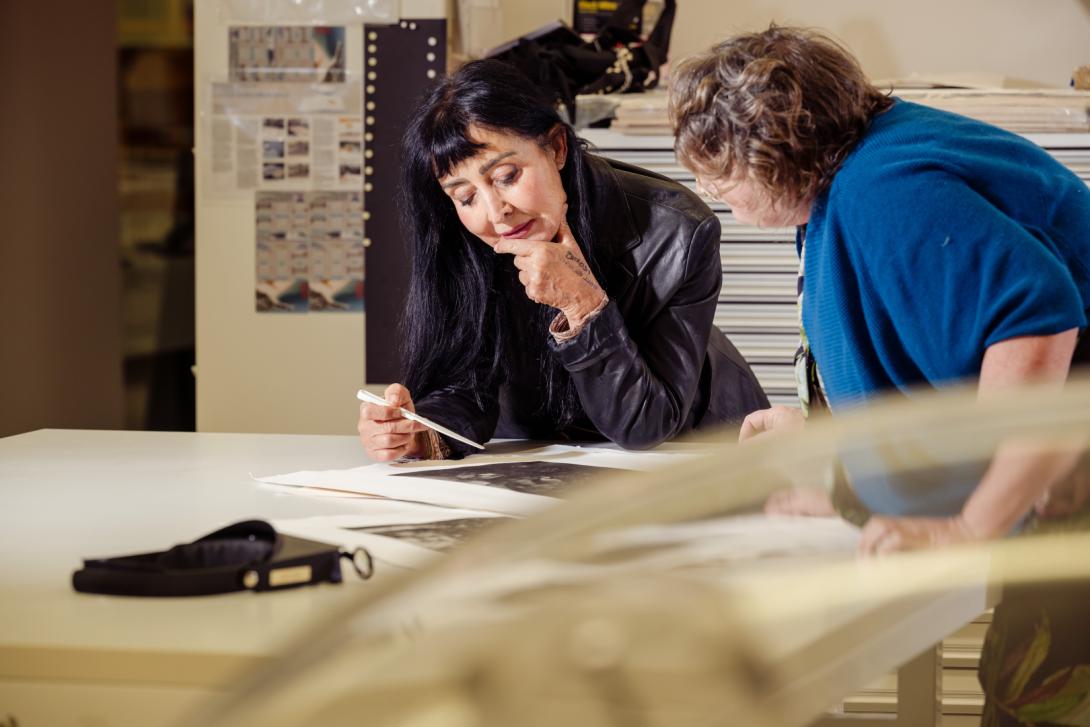
Artist Pat Hoffie and Samantha Shellard (Conservator, Works on Paper QAGOMA) reviewing Hoffie's portfolio box of prints in the QAG Conservation Lab, August 2025 / Photograph: J Ruckli, QAGOMA
SS: It is fascinating to know what compels you. What was the motivation to explore your work using the drypoint technique?
PH: Well, it’s quite simple. Before starting the residency, I had contributed to a print folio where I drew on a copper plate; the particular quality of the linework that resulted compelled me. In 2024, I was invited to participate in Cobalt Editions as a resident artist, working with master printer Tim Mosely, Jonathan Tse and Jorge Mariño Brito, to produce a folio box. Then I began creating lines on lightweight acrylic plates. Although they had a different type of touch than working the image into a copper plate, they were so convenient. I could work on them when I got a moment. I adapted to them. The drawback is you can’t produce as many prints because the burl isn’t as robust. I have been so fortunate to collaborate with Tim, who has been able to work with the properties of the printing ink and features within the acrylic plate to produce the most exceptional images. I have so much admiration and respect — energetically, we are in sync. There is so much preparation involved before you are ready to print, and there are so many elements, including the support of your printer and sympathetic print colleague, like Jorge, to produce a good print. It is so different to working solo as a painter in a studio.
SS: It is incredible to see how you have adapted your practice and responded to what you have produced.
PH: The plates are beautiful; they are objects in themselves. What I found fascinating was reevaluating my prints, especially if you have had a successful printing session. When the ink seeps into the paper, it is the most rewarding experience. When you reach the point when you pull a few good ones, you know what you want. The challenge is to get the best performance from each plate. It is a delicate balance between the ink, the application, the pressure and the paper; all of these variables influence a good outcome.
While printing using the blotter to draw the excess moisture from the paper, I was conscious of the creases of the blotter, which were sometimes stained, and the blotter looked like it had scars and was weathered. These blotters were great starting points for my monoprints, as they are injured and wounded. Still, of course, they are going to behave very differently to printmaking paper because they are very absorbent, especially in sucking up ink. I knew the images created needed to be larger, so I moved into large-scale with Dr Nina White. We produced The Background to My Days giclee prints; these enormous digital prints will feature in Gallery 14 at QAG. The high resolution captured by Nina’s deep understanding of digital technology means these images can be altered and adjusted as well as enlarged. When you stand before them and determine what you want to magnify, especially their impact, you can influence how the viewer perceives these images.
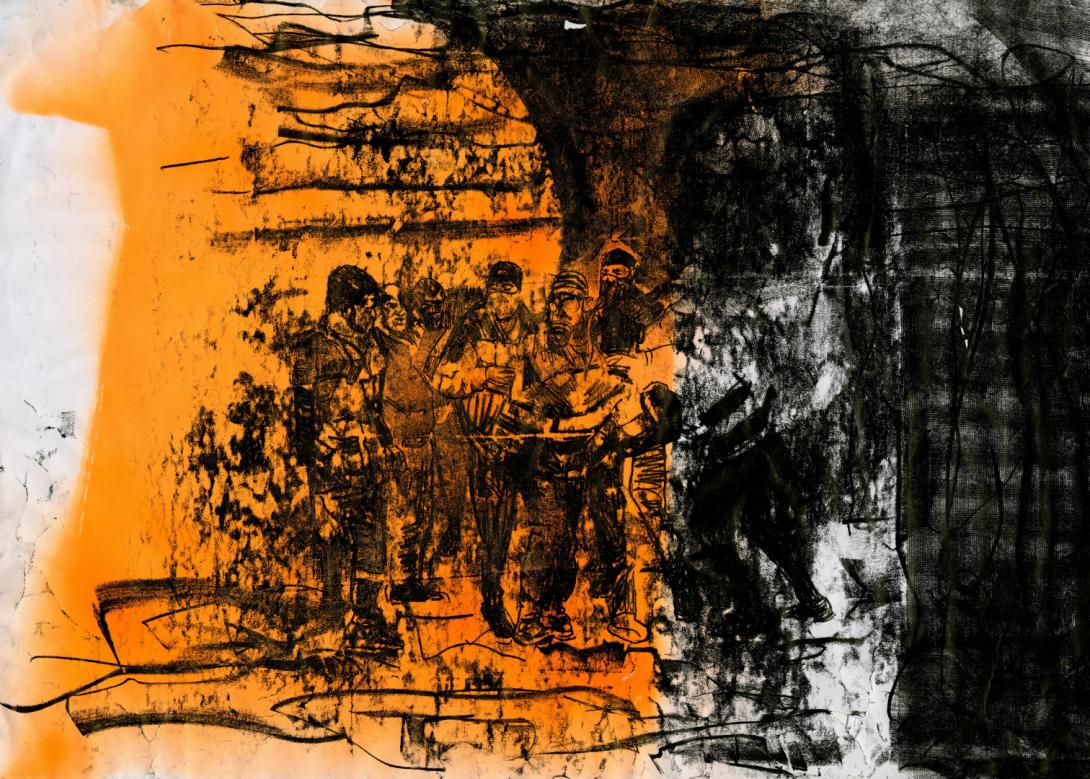
Pat Hoffie / Australia QLD b.1953 / Image from ‘I have loved/I love/I will love’ 2025 / Giclée print on paper / Courtesy and © Pat Hoffie / Photograph: Nina White
SS: Let's open your portfolio box. I want to ask about the title as Roman numerals, ‘MMXXIV’ — 2024? We are in the here and now, but these kinds of images could have happened at any time over millennia.
PH: Absolutely. These kinds of atrocities have gone on and on. History is a massive passion of mine. The more you read about historical events, the more you can see the tragic repetitions. When journalists report, ‘This is an unprecedented event’, this isn’t accurate; this is who we are as a species. Art galleries are one of the remaining institutions where we can discuss complex, uncomfortable issues in a public forum. This is a safe space where discussion can flow, and you don’t feel in physical danger. Where are we (as a society) if we lose the capacity for debate and discussion? Looking at art can help us make micro-adjustments in our thinking. We can be in the moment, open to what the artwork wants to share, and contemplate another aspect we may not have seen before. As an artist, sometimes it takes years to appreciate an artwork fully.
SS: Yes, I agree. It is crucial to create contemplative spaces with openness to investigate — to slow down and take in the entire artwork and unpack the layers of meaning. An intrinsic aspect of an exhibition layout should allow for those moments of pause to occur.
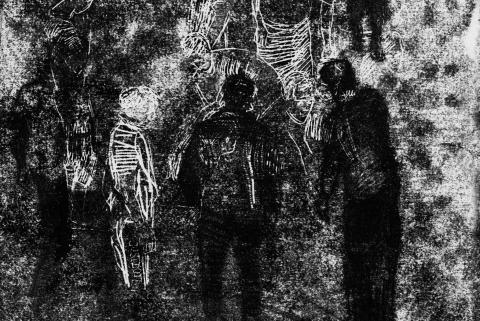
PH: Can you see the plate wipe here? This is where the ink has been wiped very carefully, where the ink has been manipulated to create contrast and atmosphere. Although the plate has the content I have scratched into it, printmaking is also nuanced by how ink is applied, what results, and how the print is interpreted — particularly when considering the range and intensity of black inks and what emerges from the shadows.
SS: Yes, I can see what you mean. You can develop an inking strategy for each plate to capture the theatrical scene. When I read each image from the portfolio, I am uncertain; I am piecing together what is playing out and what is occurring. There is a fight breaking out here, but why are people yelling? Crowds amass and disperse, and the details draw you in; they have been scratched into being, and there is a rawness and immediacy.
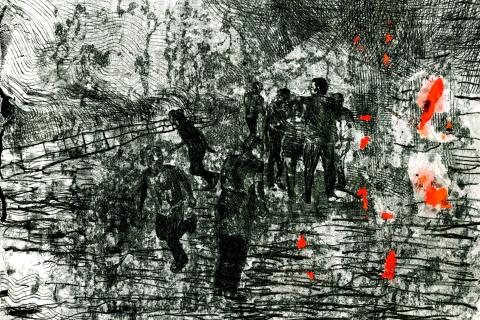
PH: Yes, you want to know what is happening in the chaos, where people, including young children, are clustered among the projecting reo rods and concrete rubble. By looking closely, you can see the interactions and relationships between the figures. This image is entirely of women milling around, receiving and distributing food. In this other one, people walk through upturned cars carrying their sacks of grain.
SS: The smoke and smouldering elements wrap like a vortex around the crowds. The figure’s body language conveys anxious searching, peering into dark holes to see what can be dragged out.
Thank you, Pat, for sharing your passion for printmaking.
Samantha Shellard is Conservator (Works on Paper), QAGOMA.
Explore ‘I have loved/I love/I will love’
Digital Story Introduction
I HAVE LOVED/I LOVE/I WILL LOVEPat Hoffie: I have loved/I love/I will love
Read ESSAY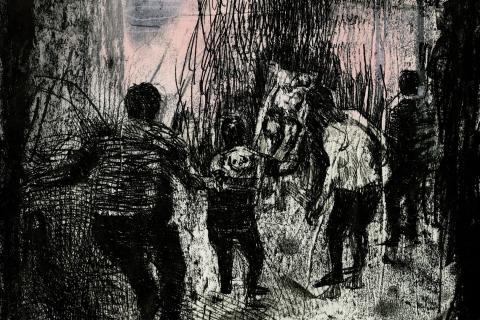
Digital Story Introduction
I HAVE LOVED/I LOVE/I WILL LOVEPat Hoffie: Only scratching the surface
Read ARTIST'S STATEMENT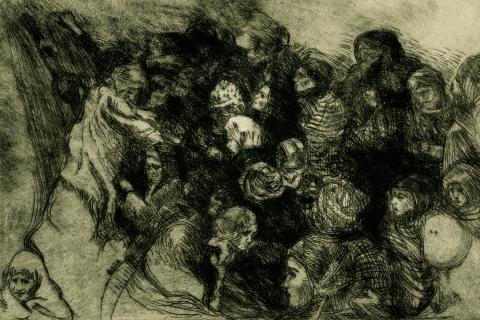
Digital Story Introduction
I HAVE LOVED/I LOVE/I WILL LOVEI have loved: Slowing down history
Read ESSAYDigital story context and navigation
I HAVE LOVED/I LOVE/I WILL LOVEExplore the story
Digital Story Introduction
I HAVE LOVED/I LOVE/I WILL LOVEPat Hoffie: Only scratching the surface
Read ARTIST'S STATEMENT
Digital Story Introduction
I HAVE LOVED/I LOVE/I WILL LOVEPat Hoffie: I have loved/I love/I will love
Read ESSAY
Digital Story Introduction
I HAVE LOVED/I LOVE/I WILL LOVEI have loved: Slowing down history
Read ESSAY
Digital Story Introduction
I HAVE LOVED/I LOVE/I WILL LOVEInk impressions: Pat Hoffie’s printmaking
Read INTERVIEW