Aisha Khalid's miniatures
By Ruth McDougall
September 2003
Aisha Khalid was born in 1972 in Pakistan. She attended the National College of Art (NCA), Lahore, from 1993 to 97, where she trained in the art of miniature painting under Imran Qureshi, whose work is also held in the QAGOMA Collection. After graduating she became a part-time teacher in the Department of Fine Art at the NCA, as well as freelancing as a textile designer specialising in block printing.
This body of work consists of six intimate paintings composed of gouache on wasli paper. The complex makeup of the Mughal miniature, which incorporates Indian, Persian and European painting conventions, is embraced in Khalid's work; using the format of the miniature, she brings together the traditions of sacred Islamic design with responses to her own diverse life experiences, to create challenging new representations. Traditionally Mughal miniatures were compiled into albums that documented the life and achievements of the Mughal emperors (1525-1862) and the great legendary tales of Persia and India. The verso of each painting was inscribed with exquisite calligraphy, while the images are framed by elaborate layers of design including exquisite floral borders. The written texts were often a synopsis of the work and were used by the artist when presenting the completed painting personally to the Emperor.
Like many art forms, the historical development and popularity of the miniature relied on the patronage of royalty. The Mughal emperor Akbar (1556–1605) played a seminal role, actively promoting the practice by appointing highly regarded Persian miniature artists for his court studios in Agra, India. Deposed Hindu Rajput princes borrowed from this popular Mughal movement, setting up their own schools of painting in new territories, and a lively exchange of artists, tales and styles ensued.
With the establishment of trade links between Europe and India in the late fifteenth century, Western influences filtered through to the Mughal empire resulting in further diversification. This ended in the 1850s when British colonial rule entered India. The Mughal and Hindu courts were dispersed and Western art schools and techniques introduced. However, by the early twentieth century the techniques and subjects of the miniature had been re-awakened, as a nationalistic response to the Western styles imposed by colonisers. In Pakistan, the NCA has played a major role in the revival and nurture of the Mughal miniature tradition. It is here that Khalid, under the instruction of Qureshi, was introduced to the potential of the traditional miniature for investigating and creating contemporary chronicles.
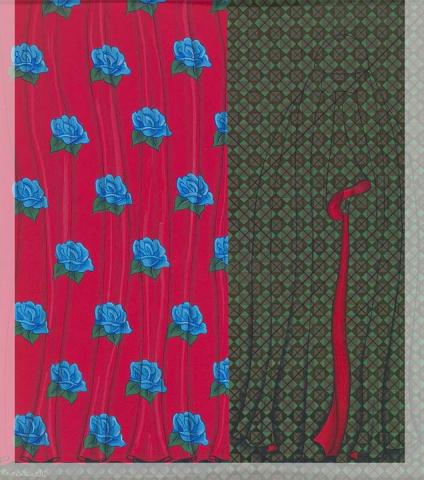
Today the imagery and subjects explored by NCA graduates are as diversely sourced as they were under Akbar. Yet where European techniques, styles and subjects had been adopted reverently in the past, they are now used for quite different reasons. Khalid is aware that many of the significant historical Mughal miniatures privileged male subjects. Her paintings investigate the inequalities experienced within a patriarchal society: In her work, curtains, tablecloths and most symbolically, the burqa (a head-to-toe garment), stand in for the under-represented female figure and are surrounded and defined by a subtle altering in traditional pattern. In some paintings the pattern becomes the subject, veiling the surface.
During the period 2001–02, Khalid undertook a residency in the Netherlands that was interrupted by the events of 11 September 2001. Her experiences studying in Europe — and her return to Pakistan in the fallout of the Al-Qa'ida terrorist attack on the World Trade Centre in New York — acted as a catalyst for new developments in her work. Coming up next 2001 was the first in this series and is an important transitional piece. Begun in Amsterdam, it was completed in Pakistan as the US retaliated against the Taliban government in neighbouring Afghanistan.
Afghanistan has played an important role in the history of the miniature. The first Mughal emperor, Babur (1483–1530), had Afghan beginnings, looking only to India when he lost his principality to a rival warlord. His autobiography, the Bāburnāma, is the first album of Mughal miniatures and records this region's turbulent history. Khalid returns to the scene after 400 years with a camouflaged table creeping sinisterly — like the TV coverage of the US invasion into Afghanistan — into the centre of her painting's domestic living room. Adjacent and behind the table, a Dutch Delft-Blue rose pulses against a blood-red backdrop.1 In this work, Khalid responds to the divisiveness of this recent series of events, shutting each side into their closed worlds. This is enhanced by the formal splitting of the painting into two parts.
Endnote
- Delftware is a type of Dutch porcelain famous for its distinctive rich blues.
Connected objects
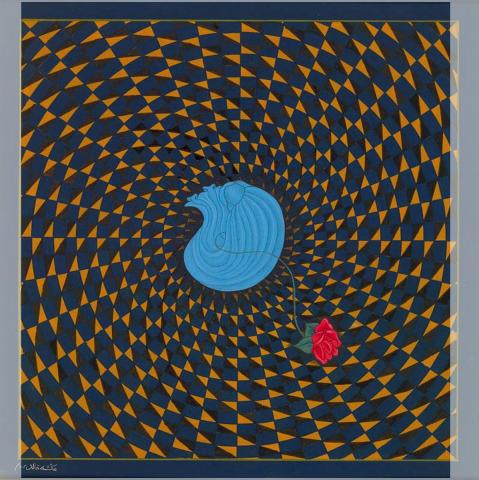
Birth of venus 2003
- KHALID, Aisha - Creator
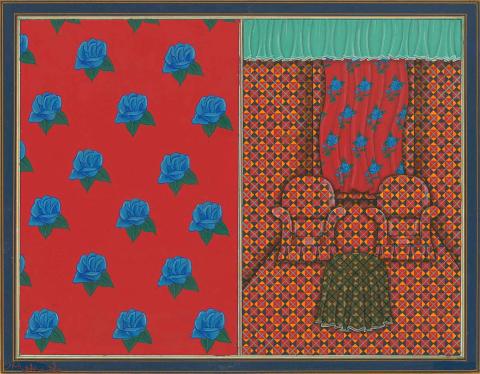
Coming up next 2001
- KHALID, Aisha - Creator
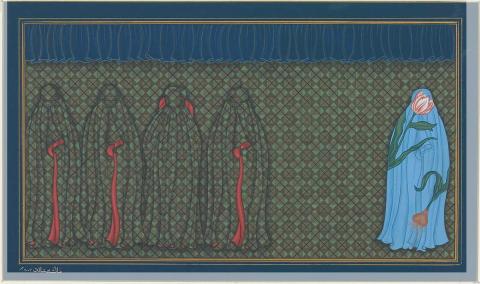
Exotic bodies 2003
- KHALID, Aisha - Creator
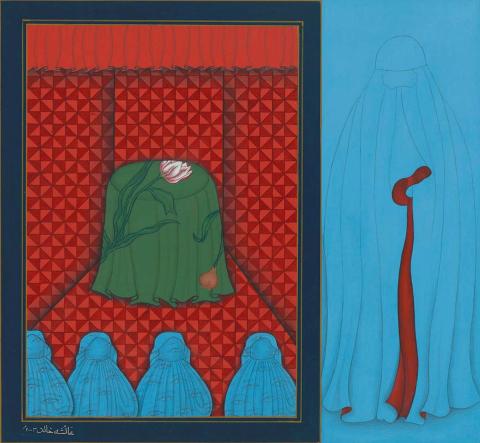
Ongoing conversation 2003-04
- KHALID, Aisha - Creator

Visible/invisible 2003
- KHALID, Aisha - Creator
Visible/invisible 2003
- KHALID, Aisha - Creator