The God of Small Things
By Reuben Keehan
Artlines | 3-2025 | September 2025
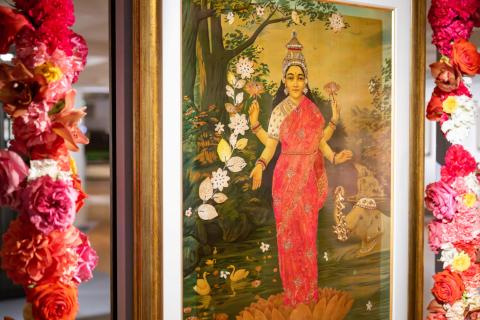
Drawing its title from the evocative Booker Prize–winning novel by Arundhati Roy, a new exhibition at QAG explores the juxtaposition of religious and vernacular iconographies in art and popular culture. While the exhibition centres on a rare collection of embellished oleographs by Indian artist Raja Ravi Varma (1848–1906), which arrives in September, the gallery space currently features an early showing of complementary works drawn from the Gallery’s holdings of contemporary Asian art, introduced here by Reuben Keehan.
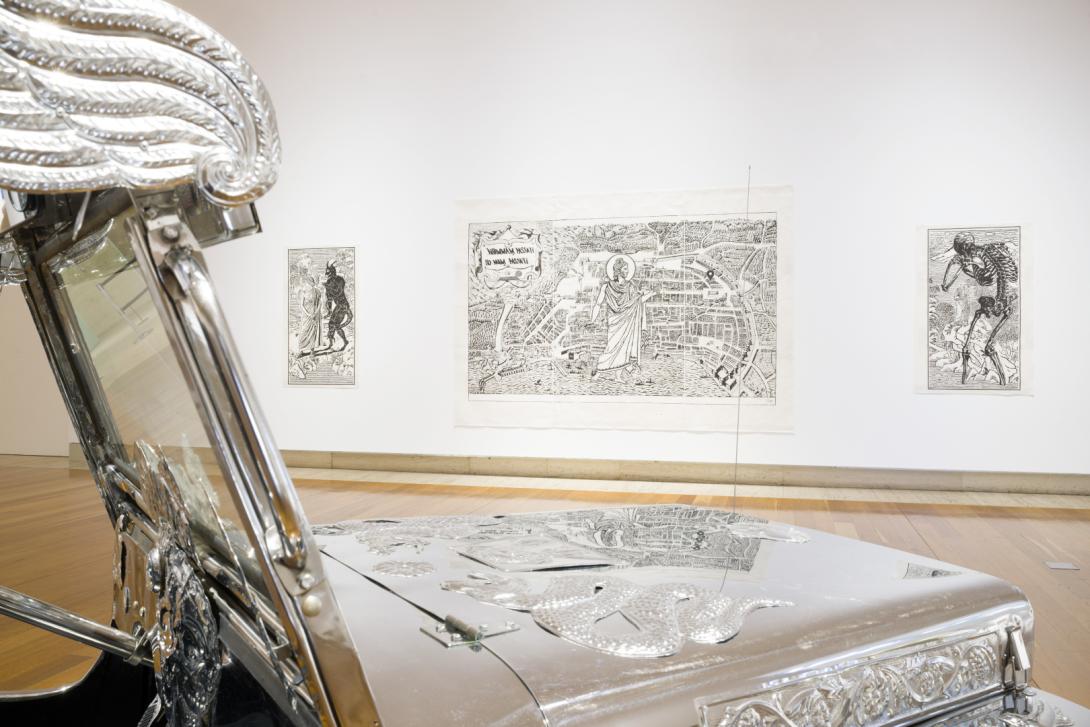
Works by Isabel and Alfredo Aquilizan and Natee Utarit installed at QAG for 'The God of Small Things', August 2025 / © The artists / Photograph: C Callistemon, QAGOMA
Presented in Gallery 5 and 6 of the Henry and Amanda Bartlett Galleries at QAG, ‘The God of Small Things: Faith and Popular Culture’ (2025–26) explores the omnipresence of faith in the mundane and extraordinary alike through works of art, contemporary and historical, held in the Gallery’s Asian art collection. Featuring works by Sonabai and her son Daroga Ram, Kalam Patua, Kalu Ram, Pardhan-Gond artists Jangarh Singh Shyam and his nephew Venkat Raman Singh Shyam, Lê Thúy, Mai Nguyễn-Long, Soe Yu Nwe and more, the exhibition was curated around the acquisition of a series of oleographs created by Raja Ravi Varma that have recently entered the Collection, purchased with funds from the Henry and Amanda Bartlett Trust through the QAGOMA Foundation.
Ahead of the installation of Varma’s oleographs, and occupying the centre of the exhibition space, Isabel and Alfredo Aquilizan’s gleaming, stainless-steel sculpture In God We Trust (version 2) 2009 fuses the Filipino visual traditions of fine metalwork, prison tattoos and, most prominently, the ‘jeepney’: old military jeeps and other vans modified for public transport, characterised by their vibrant, attention-grabbing designs. The work’s title, which appropriates the motto that appears on United States currency, is a phrase prevalent in vernacular decoration in the Philippines, where it resonates strongly with the country’s widespread practice of Folk Catholicism. While the Aquilizans reference the Philippines’ abiding legacies of North American and Spanish colonialism, the artists simultaneously celebrate the Filipino embrace and reinvention of external influences.
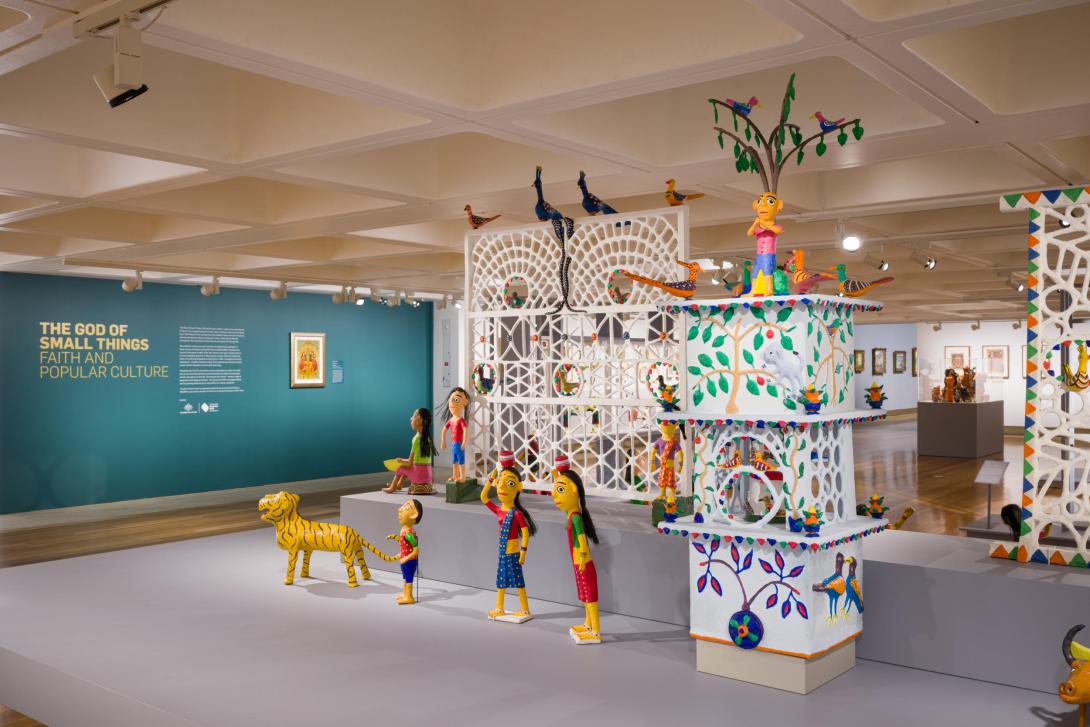
Works by Sonabai and artists influenced by her, installed for 'The God of Small Things', QAG, August 2025 / © The artists / Photograph: C Callistemon, QAGOMA
Nearby, a selection of works by Santiago Bose includes a set of recently gifted hand-painted ceramics. These incorporate designs and drawings derived from the iconography of anting anting talismans, interweaving geometric, figurative and animistic references from vernacular, Indigenous and Catholic symbolism. Through these ceramic works, Bose explores what he has referred to as ‘the invisible world that is ingrained in the Filipino psyche’, including belief in the abilities of shamans and faith healers, and in the power of specific objects or symbols to act as talismans or amulets, protecting the wearer from illness, injury and even death when empowered by rituals and incantations. Associated with people’s uprisings against colonial and dictatorial regimes, anting anting embody a cultural memory of resistance.
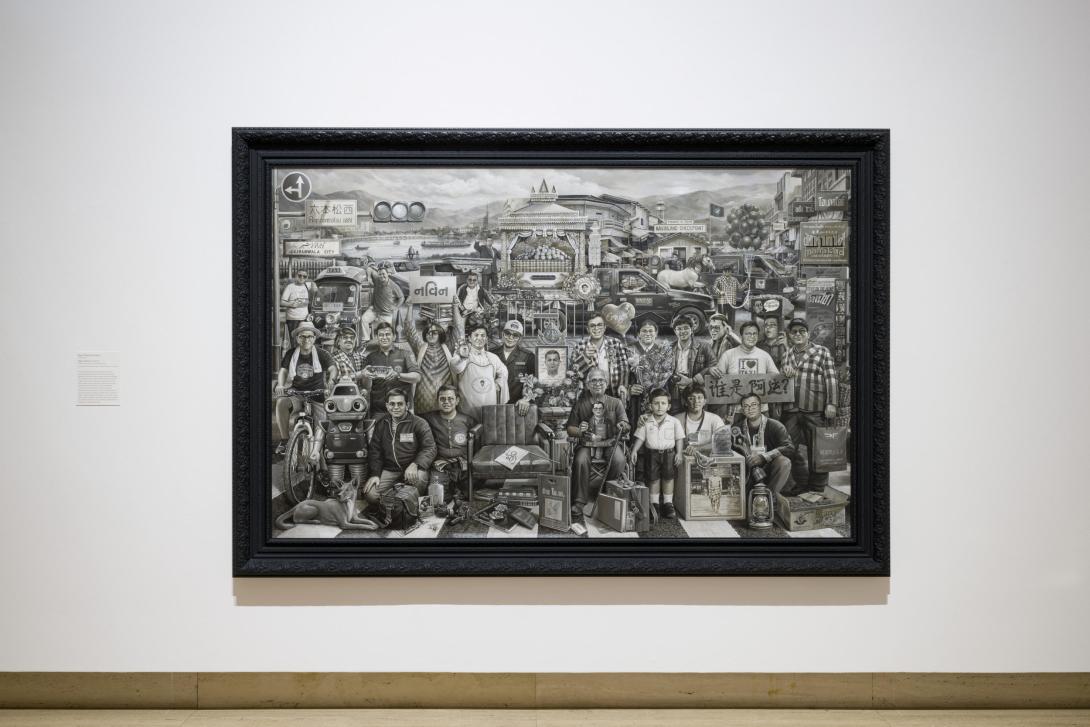
Navin Rawanchaikul's Tales of Navin 2 2013–15, installed at QAG for 'The God of Small Things', August 2025 / © Navin Rawanchaikul / Photograph: C Callistemon, QAGOMA
A figurative panorama Tales of Navin 2 2013–15 by Navin Rawanchaikul is a group painting of self-portraits, comprising multiple depictions of himself at various ages, with a host of guises and characters he has performed throughout his life and career. City, street and shop signs flag moments in the artist’s career, showing catalogues, travel bags and toys, and reflecting his movement between Chiang Mai, Thailand, and Fukuoka, Japan. Amid the buildings, rikshaws, cars, a bicycle and a horse, a pickup truck joins a funerary procession, bearing a coffin under a canopy of flowers. Highly detailed and executed on a dramatic scale, Tales of Navin 2 explores a personal, humble and emotional story of life, relationships, loss and death in Rawanchaikul’s characteristic light-hearted style.
Accompanying these works are recent gifts including Thai artist Natee Utarit’s epic, large-scale woodblock prints from his ‘Déjà vu’ series; Li Jin’s dramatic, Tibet-inspired fine-brush painting Guanghuan (Aura) c.1985–87; and a set of three cast-metal skulls referencing Buddhist imagery, by Mongolian artists Nomin Bold and Ochirbold Ayurzana, derived from their impressive installation in the eleventh Asia Pacific Triennial. A suite of five prints by Japanese provocateur Takashi Murakami reflects an overlap between the artist’s longstanding interest in manga, his more recent turn toward the narratives and iconography of Buddhism, and the capacity of flowers to take on meaning in faith and popular culture alike.
Reuben Keehan is Curator, Contemporary Asian Art. ‘The God of Small Things: Faith and Popular Culture’ is at QAG from 20 September 2025.
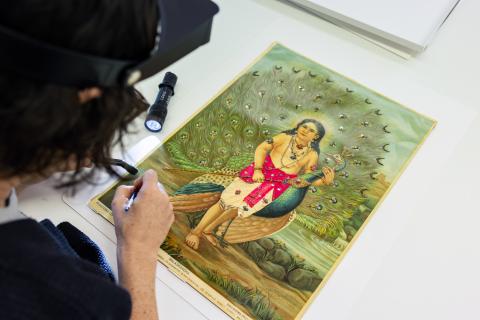
QAGOMA’s Raja Ravi Varma oleographs conservation and research exchange is supported by the Centre for Australia-India Relations. QAGOMA is proud to be the recipient of a Centre for Australia-India Relations Maitri grant.
Digital Story Introduction
The Raja Ravi Varma Conservation ProjectRaja Ravi Varma's legacy and influence
Read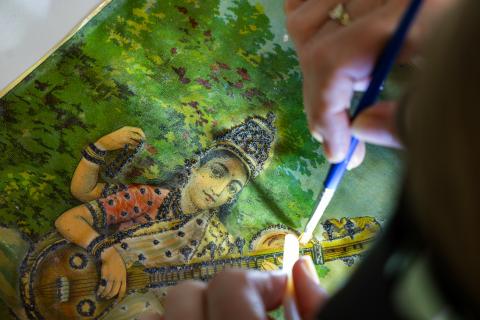
Digital Story Introduction
The Raja Ravi Varma Conservation ProjectConserving Ravi Varma oleographs
ReadDigital story context and navigation
Explore the story
'The God of Small Things'
Sep 2025 - Oct 2026